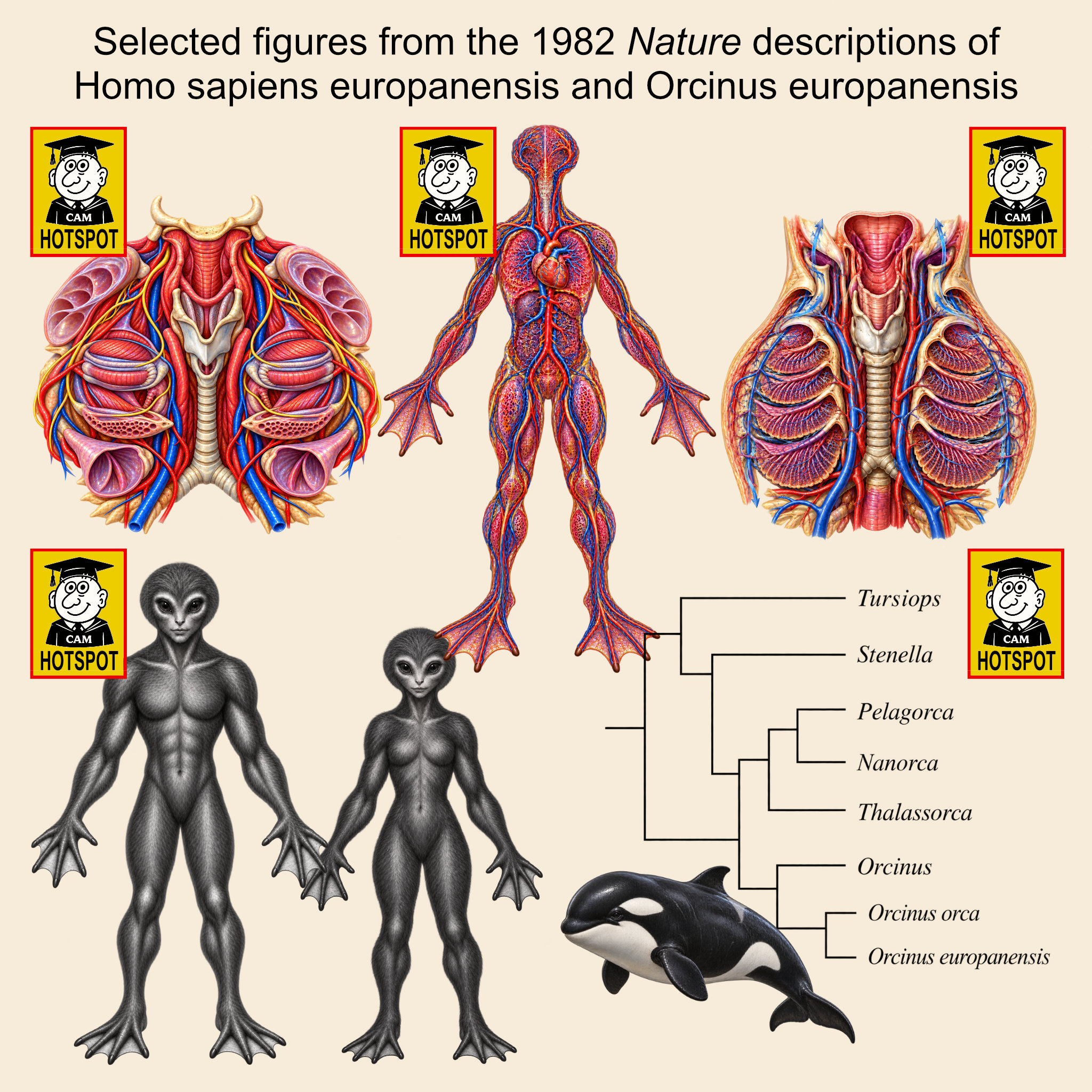
Deus ex Machina Primordialus
Despite nearly identical genotype (genes), Europans differ substantially in phenotype (bodies, the expression of those genes). Many features are familiar adaptations to aquatic life: dense insulating fur, dark-adapted vision, webbed hands and feet, and modifications for underwater vocal communication. But Europans are unique among aquatic mammals in the extent of those adaptations, which include radical changes allowing them to breathe and live permanently underwater.
It might be argued that all the adaptations, including those pictured above, differ only in magnitude or mechanism from those found in other aquatic animals. However, no known mammal has evolved true water breathing, and comparable adaptations for deep diving and underwater communication took far longer than four million years to evolve in cetacean ancestors.
The strongest argument against entirely natural causation may be Occam’s Razor, which requires an explanation that makes the fewest unsupported assumptions for these two inconvenient facts: 1. Europans evolved 390 million miles away on a moon of Jupiter; and 2. the shattered body of a new cetacean species, differing from its terrestrial relatives principally in dwarfism, was found in the hold of the Europan mining vessel.
Humanity now confronts indisputable evidence of a godlike Deus ex Machina (DeM) transporting breeding populations of Ardipithecus and Orcinus to live in an ice-covered ocean on a moon of Jupiter. Current theories fall mainly into two camps: 1. Moral Guidance, the DeM serve an ethical/religious purpose; and 2. Whimsy, the DeM just like to muck about.
CAM refers to this evidence as the Gould Experiment, a Whimsy theory that posits the DeM transporting and bioengineering an Ardipithecus population in order to watch the Europan and Earth lineages evolve in radically different environments. The cetaceans may have been an afterthought; perhaps another intelligent mammal for company, albeit a voraciously predatory intelligent mammal.
We suspect there was a bet involved.
