Other Lines of Evidence
Europans are our close relatives. To learn just how close, UC Berkeley biochemists Allan Wilson and Vincent Sarich were invited to the Internment Lagoon in 1968. They were well known for recent immunological comparisons of serum proteins estimating the human–great ape divergence at about 5 MYA. That result met strong backlash. Paleontologists were skeptical of biochemical evidence, and there was scant fossil evidence for a human ancestor from that era.
At the Lagoon, the scientists found that the Europan–great ape distance matched the roughly 5 MYA human–great ape divergence. By 1970, accumulating fossil evidence had increased support for both the human and Europan chronologies.
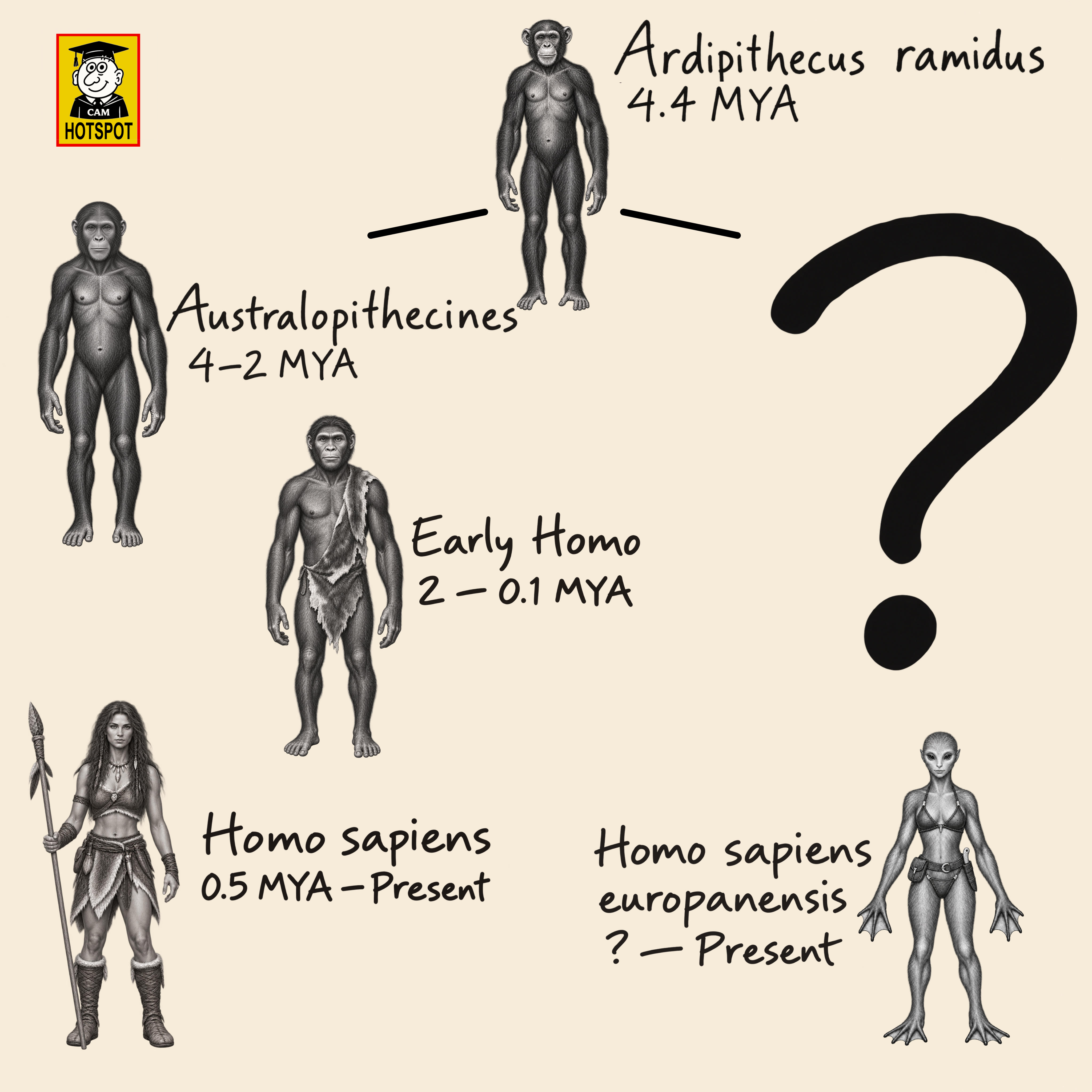
By 1982, DNA evidence agreed with the earlier protein evidence: Homo sapiens and the Europan population shared a common ancestor that split from other primates about 5 MYA, and the two populations shared 95% of their DNA.
That same year, UC Berkeley paleoanthropologist Tim White formally named the Europan population Homo sapiens europanensis, using Nö as the type individual. In a companion article published the same day, Smithsonian cetologist James Mead described Kutya as the holotype of Orcinus europanensis (orca from Europa), a dwarf killer whale whose anatomy and DNA placed her squarely within the orca lineage.
In 2009, Tim White's years-long reconstruction of Ardi, a 4.4-million-year-old early hominin, provided the final piece of the puzzle. Ardi was the likely common ancestor of terrestrial and Europan Homo sapiens.
