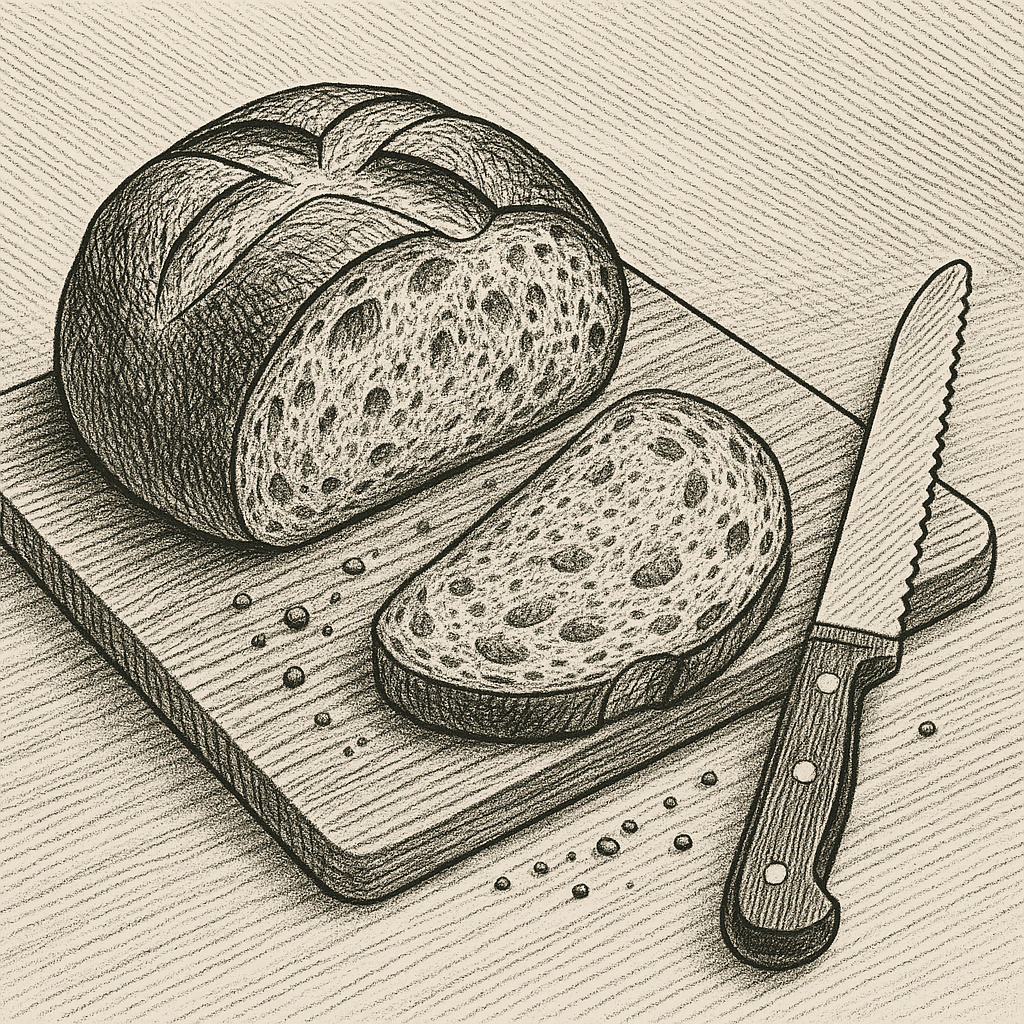
Recipe photo or drawing (placeholder)

Social Capital Sourdough

Bake bread and influence people.

Ingredients

Volumes are shown as fractions of a cup. Amounts ≥ 1 cup are rounded to the nearest 1/16 cup (1/16 C = 1 Tbsp). For example: 9/16 C = 1/2 C + 1 Tbsp)

↩ Back to Rye & Whole Wheat Version

Mixing

  1. Mix flours and salt in a bowl.
  2. Add very warm water to a large mixing bowl.
  3. Add starter to water and mix thoroughly
  4. Add dry ingredients and mix until no dry flour is visible..
  5. Cover and rest for 1 hour.

↩ Back to Rye & Whole Wheat Version

Stretch & Fold, and Rise/Bulk Fermentation (BF)

  1. First stretch and fold: Stretch and fold for 1-2 minutes until you feel the dough becoming more elastic, i.e, more resistant to your stretch. Rotate the bowl a quarter turn after each stretch.
  2. Cover and let rest for 1 hour.
  3. Second, third, and fourth stretch and fold: Stretch and fold 4 times, rotating the bowl a quarter turn each time, then let rest, covered, for one hour.
  4. Check dough rise before the fourth and final stretch and fold. If the dough has already risen to target percentage (See Target Rise % Guide in section notes), skip the remaining stretch and fold and proceed to the Shape and Cold Retard section.

↩ Back to Rye & Whole Wheat Version

Shape & Cold Retard

  1. Pour out dough onto lightly floured surface. It should be be smooth side down. In other words, the dough that was on top while in the bowl is now in direct contact with the table.
  2. By reaching under the dough with your hands facing up, use your fingers to spread the dough out in a roughly rectangular shape, and to pull the the dough to that the thickness is roughly the same throughout. Don't try for perfection, just a rough approximation.
  3. Grab a corner and pull it to the center. The sticky side is on top, so the dough will stick to itself. Repeat for the other three corners. You should have a packet of dough in a roughly circular shape.
  4. Using bench scrapers, flip the dough over.
  5. Cup your hands around the sides of the dough, and, with short, quick motions (to minimize sticking), rotate the mound of dough in the same direction for 2-4 complete revolutions. You are tightening the dough.
  6. Cover with a flour sack towel (to minimize sticking) and let it rest for 30 minutes.
  7. Uncover the dough and very gently flatten it.
  8. Then, by reaching under the dough with your hands facing up, use your fingers from underneath to gently pull and spread the dough into a roughly circular shape of roughly regular thickness.
  9. Pull an edge up and fold it to the middle and stick it gently to the middle. Repeat this sequence; pull the edge up, fold it to the middle, and stick it to the middle around the full circumference of the dough circle. Then, if the dough allows, keep working your way around the circumference 1 or two more times, or until the dough is too tight to continue. That tightness is exactly what you want to create.
  10. Using bench scrapers, flip the dough over and let it rest for 1-2 minutes in order to secure the seam, and to give you time to prepare the boule.
  11. Flip it over into a floured banneton (it should now be seam side up).
  12. Leave in refrigerator at least 24 hours, and up to 4 days.

↩ Back to Rye & Whole Wheat Version

Bake

  1. Preheat oven to 500º F with dutch oven on shelf in lower half of oven
  2. After preheating, stage your oven mitts, boule, scoring tool, and sheet of parchment parchment paper near the stove
  3. Remove dutch oven from stove but leave the lid on.
  4. Flip boule over onto the parchment paper (it is now seam up), and score the dough.
  5. Uncover dutch oven, place dough in it, replace the lid, and return it to oven.
  6. Bake for 20 minutes.
  7. Remove dutch oven lid and remove the lid from the oven, reduce heat to 450º F, and continue baking until internal temp is about 200º F (20-30 more minutes). Alernatively, just bake till it's brown enough for you.

Nutrition per Loaf

CaloriesProtein (g)Fat (g)Fiber (g)Carbs (g)Sugar (g)
2548 79.8 83.0 60.5 430.7 94.6

Totals are approximate; brand, milling, and measurement differences affect results.

← Back to Baking Menu Page

Rye and 100% Whole Wheat Versions

100% Whole Wheat Sourdough recipe adjustments and comments

Both rise and crumb openness will be dimished proportionally to the amount of whole wheat flour. 85% whole wheat will rise the least and have the densest crumb. For a good flavor to rise/crumb compromise, replace 300 g of the bread flour with 300 g whole wheat flour.

If you insist on good rise and crumb, but still want to try very high whole wheat percentages, consider white whole wheat instead of red. It's just as healthy as red whole wheat, and impairs rise and crumb somewhat less. Many people prefer the taste (chacun a son gout), but it lacks red's nutty, earthy, and bittersweet flavor.