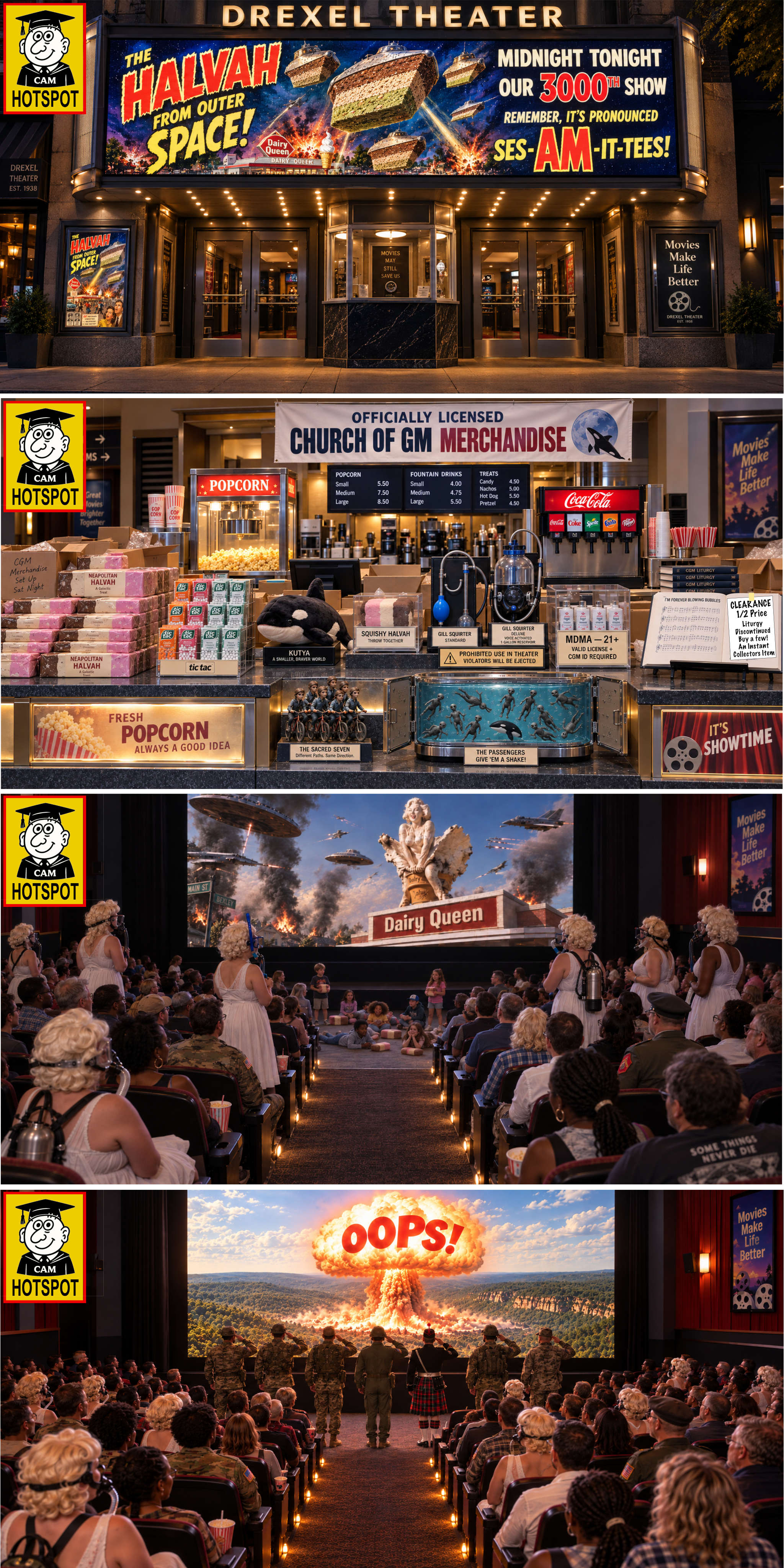
MD: I should disclose that my interest in you began with my brother Kevin. JB: Should I be worried? MD: Usually. He’s a conservative Catholic and regards your schism as somewhere between apostasy and a hostile takeover. He also assumes the Church of GM is another left-wing conspiracy in religious drag. JB: Has he met any GMrats? Bring him Saturday. MD: You think he’d be comfortable? JB: Politically? He’d have plenty of company. MD: I'll consider it. Give me the one personal characteristic that is fundamental to your success. JB: I’m lucky. Does that count? MD: Give me a little more and I’ll let you know. JB: I grew up at Europan ground zero. We knew they had landed, but we didn’t talk about it. Not publicly. My dad owned the place, so I was cleaning bathrooms and ushering for Sesamites Attack! and then running the theater by the time they made the last one, Invasion of the Joyva Bars. MD: I’ll allow “lucky.” When did luck turn into the Church of GM? JB: I loved Halvah from Outer Space from the start. It bombed, so I got it cheap for midnight shows, and it caught on here immediately. Before long, the audience was already getting creative. MD: People throwing things and yelling at the screen. JB: That was the visible part. And I watched something else bubble up. The same people came every week and more piled on. Then the weirdness spread to theaters around the region, especially college towns like Athens and Oxford. MD: College students discovering midnight movies is not exactly Lourdes. JB: No. But they weren’t just coming back for the movie. They were coming back for each other. MD: So when did a few gags become religion? JB: I’m still figuring that out. The short answer is that we were the first generation to grow up knowing we weren’t alone, that there was another human race, and that something powerful had interfered with both of us. Somehow Halvah became the place where GMrats celebrated those truths together. MD: That’s unexpectedly theological for a man selling Tic Tacs in the lobby. JB: You can do both. MD: You were in the right place at the right time. Lots of people manage that without becoming enormously rich. What did you actually invent? JB: The package. MD: Meaning? JB: I tied up the Halvah distribution rights. Then I stopped selling theaters a movie and started selling them Saturday night. MD: There’s the businessman. JB: Exactly. The theaters got the film, promotional material, the participation guide, access to licensed merchandise and instructions for building the kind of repeat audience we already had at the Drexel. The theater kept its admission and concession revenue and a piece of merchandise sales. We got licensing and distribution revenue. MD: And eventually the chains decided they could tolerate a little sacrilege if the popcorn numbers were good. JB: Chains are very ecumenical about revenue. MD: You didn’t create the movie, the rituals or GM. You monetized the congregation. JB: I organized it. There’s a difference. MD: A profitable one. JB: Very. MD: Which made you an extraordinarily rich man. Your critics use less flattering descriptions. Jim Bakker comes up. JB: Different spelling. MD: I knew you’d say that. JB: I’m rich because I own businesses with licensing and distribution interests in the films and merchandise. Those businesses pay taxes. CGM is separate. MD: And also extremely rich. JB: CGM takes in more than twice what my companies do, mostly from dues, donations and its own licensing agreements. I can’t take that money. Every penny after operating costs goes to charitable work. MD: Your favorite statistic is that last year the CGM Founders Trust gave away more than the combined Catholic dioceses of New England. JB: It’s a good statistic. MD: Particularly for a priest who engineered a schism from the Catholic Church. JB: I’m a bad Catholic. MD: But apparently a competitive one. JB: Apparently. MD: Is charity part of the sales pitch? Join the Church of GM, have fun at the movies and save the world? JB: I appreciate the lob. Yes. Charity is what we’re about. I designed the institution so that whatever happens to the movie, the merchandise or me, CGM remains primarily a charitable organization. MD: What counts as charity? JB: We’re an open book. Read the annual report. But I’ll boil it down. Even a bad Catholic is still a Catholic. Good works come down to First Principles: feed the hungry, house the homeless, care for the sick and preserve life whenever possible. MD: I went to the midnight show last Saturday. Research. JB: Of course. MD: I was not prepared for the gift shop. JB: Nobody is. MD: Halvah, Tic Tacs, squishy toys, gill squirters. And one thing on clearance: the CGM Liturgy. Why was that discontinued? JB: Because it was a mistake. MD: Yours? JB: Completely. I thought we should collect the rituals, write them down and give new congregations a place to start. MD: It wasn’t selling? JB: It was a perennial. Danny Rosen, my CFO, plotzed when I told him we were discontinuing it. MD: And you did it anyway. JB: We’d taken something thousands of people were inventing together and told them how to do it. MD: You’d invented dogma. JB: Worse. I’d invented instructions. MD: For a church you were trying to standardize and license worldwide. JB: That’s why it took me a while to see the problem. The business wanted consistency. The Church needed the opposite. MD: So no official liturgy. JB: People still call it the liturgy. We just don’t get to write it. MD: Your members also pay dues and buy an astonishing amount of Church merchandise. Isn’t there something circular about a charity making money from the people who belong to it? JB: Every church passes the collection plate. We just charge people according to what they can afford. Dues and merchandise are adjusted by income. The top tier pays close to retail. At the bottom, discounts can reach 75 percent, sometimes below our cost. MD: Which requires people to tell their church how much money they make. JB: Yes. MD: And prove it? JB: No. MD: No tax return? Pay stub? JB: Nothing. They tell us. MD: You simply take their word for it? JB: Why not? MD: Because you’re a businessman. JB: That’s why. My hunch is that showing people trust increases our net revenue. I can’t prove it, but we seem to be doing all right. MD: And the people who aren’t members? JB: Gentiles come to services and buy merch, too. At full retail.
I came to Bexley expecting to meet a priestly P.T. Barnum who had discovered that religion, intellectual property and snack food make an unusually profitable trinity. I did meet him. The problem is that Jay Baker also seems to believe every word he says about First Principles. His companies pay taxes, his church gives away its money, and neither Baker nor his accountants seemed especially interested in helping me find the hypocrisy I had come looking for.
Baker makes no apology for being rich, and none for making the Church of GM rich. He appears to regard profit as neither virtue nor sin, but simply something useful that happens when you give people something they want. In his case, that turned out to be a terrible movie, a place to belong, and an excuse to do some good.
As I was leaving, Jay suggested I title this article, “The Reverend Behind the Revenue.” I liked it enough to pass it along. I won’t know whether they used it until I read the paper.
Church of Merch
GMrats love the merch, available only at Halvah showings. They get big (sometimes VERY big) discounts on CGM merchandise and audience-participation items like halvah and Tic Tacs. In 2022, MDMA arrived with a big splash. After 15 years of patient petitioning and politicking, CGM was granted a DEA exemption. CGM was adamant that MDMA is the analog of the Europan Sacrament, and all the most influential Europans submitted briefs to the DEA in support.
Standing Marilyns Ritual
The Standing Marilyns bit continues to evolve. The carved Dairy Queen cone now takes second stage to the seven drugged children killed at Schaefer's Massacre. As the Battle of Bexley begins, school age children move to the front of the theater. People in the front row gently throw halvah or squishy toy halvah at them, as they lie down.
As the scene ends, the Marilyns, now wearing rebreathers, go to the children and solemnly walk them back to their guardians, while wailing and crying. A recent and popular wrinkle is catching on. The children are now wailing and crying as well. It looks like a lot of fun.
The Tosi Platoon
Almost as old as the Marilyns, the OOPS! scene is accompanied by men (The Tosis) in military field kit, at attention and saluting. A variant growing in popularity has the Tosis march to the front in close-order formation. Lt. Tosi (now General Tosi) was one of the earliest victims of the Europan incident to be canonized by the CGM. Appropriately so, as he was also one of the first terrestrials to suffer harm.
GMrats
Reaction to GM is mixed. Established religions accommodate GM with minor doctrinal adjustment. Politicians find that constituents' political affiliations are unaffected, so governments ignore it. GM websites and social-media accounts have less reach than even moderately popular influencers. Academia, however, is deeply engaged. GM has been the subject of more than 47,000 philosophy books and textbooks in the 45 years since the 1980 declassification. GM curricula exist at virtually every institution of higher learning worldwide.
Aside from philosophers, people aren't very interested in GM, with one spectacular exception: GMrats (JIM-rats). GMrats comprise the fastest-growing religious movement of the modern era. This grassroots church evolved from the late-night audience-participation screenings of The Halvah from Outer Space. As information and misinformation about Europan events spread during the '60s and '70s, both attendance and audience participation expanded rapidly. That's when Father Jay Baker stepped in.
Father Jay was an indifferent Catholic priest but a talented businessman. He had inherited Bexley's Drexel Theater and saw two opportunities at once: an entertainment phenomenon and a genuine community with shared rituals. He created companies to manage film rights, distribution, licensing, and merchandise, then engineered a schism from the Catholic Church to found the Church of GM (CGM). A tax-exempt nonprofit, CGM licenses its promotional and branding assets, collects royalties and donations, and spends that income on charitable work.
The crowd-sourced innovation and expansion of the church's liturgy, rituals, and iconography continue to this day, greatly accelerated by social media and by the logistical and financial support of CGM. About 80% of the more than one million GMrats attend services in person or by streaming at least once a month. About 1,500 churches/movie theaters worldwide are “officially participating.” The demographic leans young but is otherwise a big tent, encompassing the full spectrum of political, religious, ethnic, and socioeconomic circumstances.
Read Maureen Dowd's interview of Mr. Baker for the New York Times, "The Prophet Behind the Profits." Use the first CAM HOTSPOT (top left) of the above image.