Danny’s Last Kaddish

j&d1 j&d2

Panel 1. Preamble, Part I

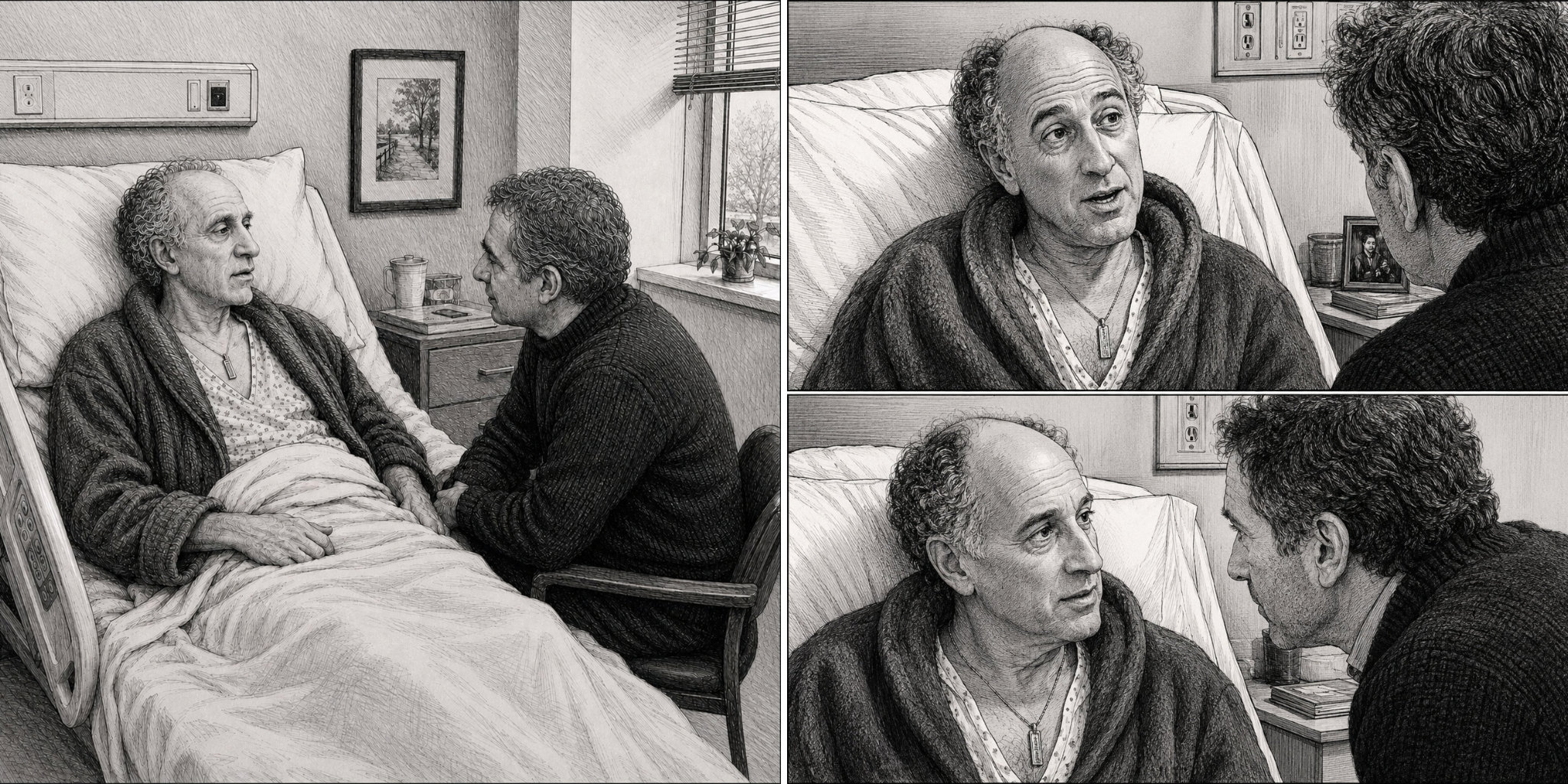
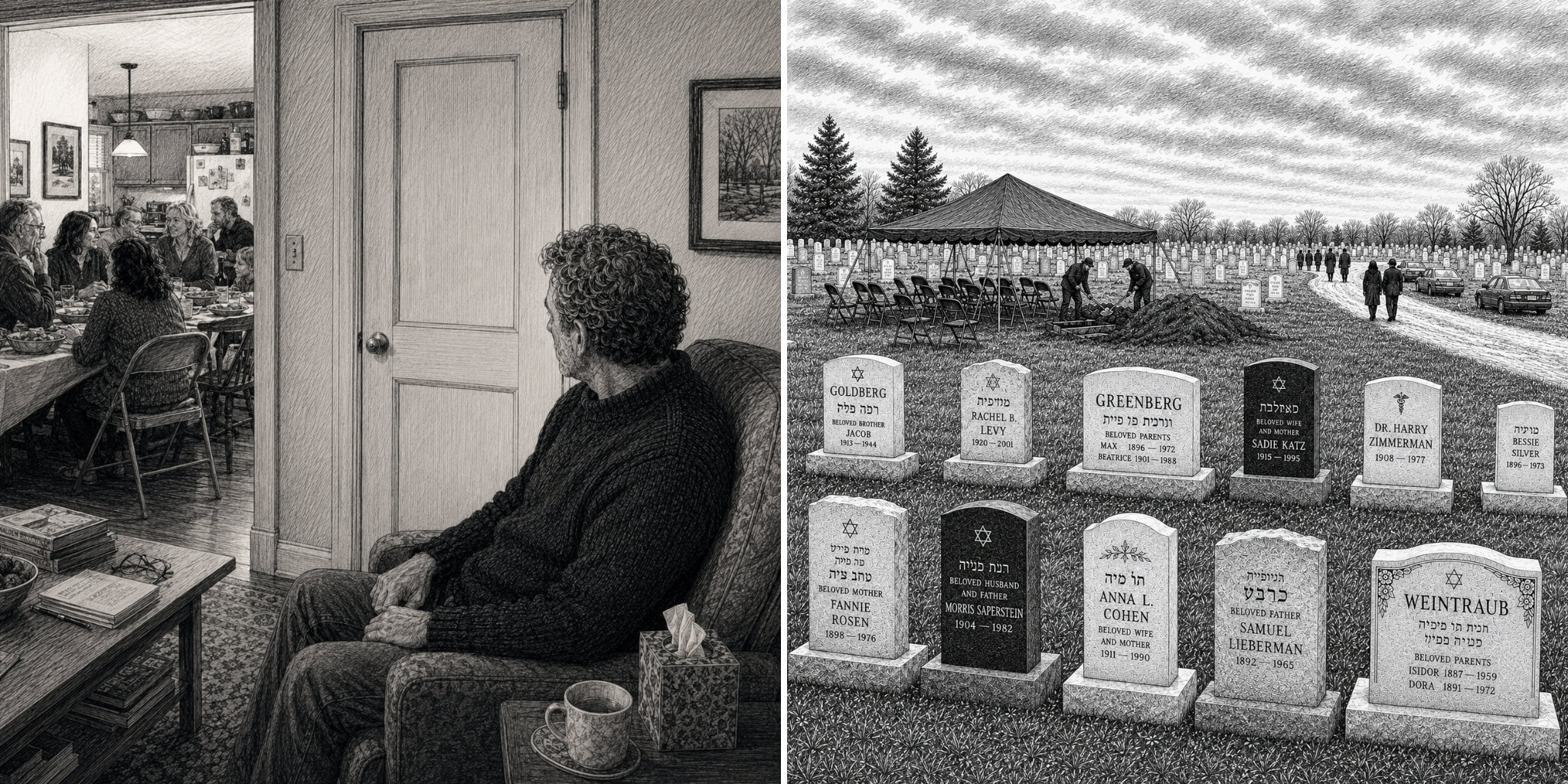
Danny lies in the hospital bed, skeletal from pancreatic cancer. We’re alone, talking about nothing much. But he suddenly looks at me intently and says, “Is this it?”

I lean in to ask him what he’s feeling. But a friend of his walks in on us, and the moment’s gone.

dan bedroom cemetary

Since arriving in Columbus for my brother’s last weeks of life, we’re never alone. The multitudes who love him and Nancy are always at the house sharing food and gossip and laughter. I sometimes hear him and Nancy, alone in their bedroom, crying together, and I envy them. That “Is this it?” was the only chance I got to hear him out.

Within a few days, he retreats into coma and dies shortly after.

phonepals alone path

Panel 2. Preamble Part II

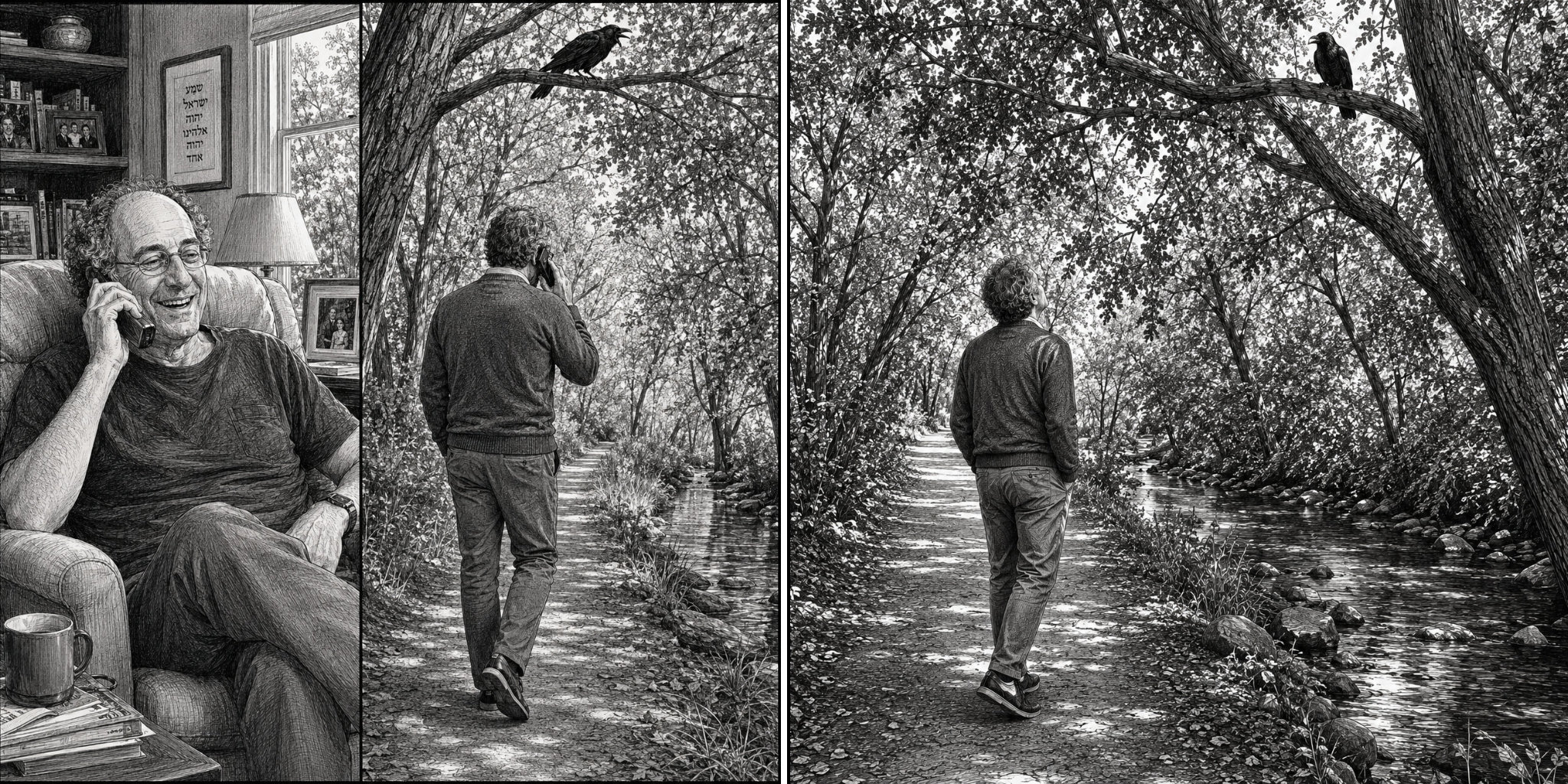
During Danny’s illness, I attended Shabbos morning services at my town’s little Chabad to offer his name for the Mishabeyrakh, the prayer for the sick. Danny was an observant Jew who attended his Chabad often. He was pleased that I, a nonbeliever since before Bar Mitzvah, was going to shul. I always phoned afterwards and we’d laugh about my discomfort and my clumsy navigation of Jewish ritual.

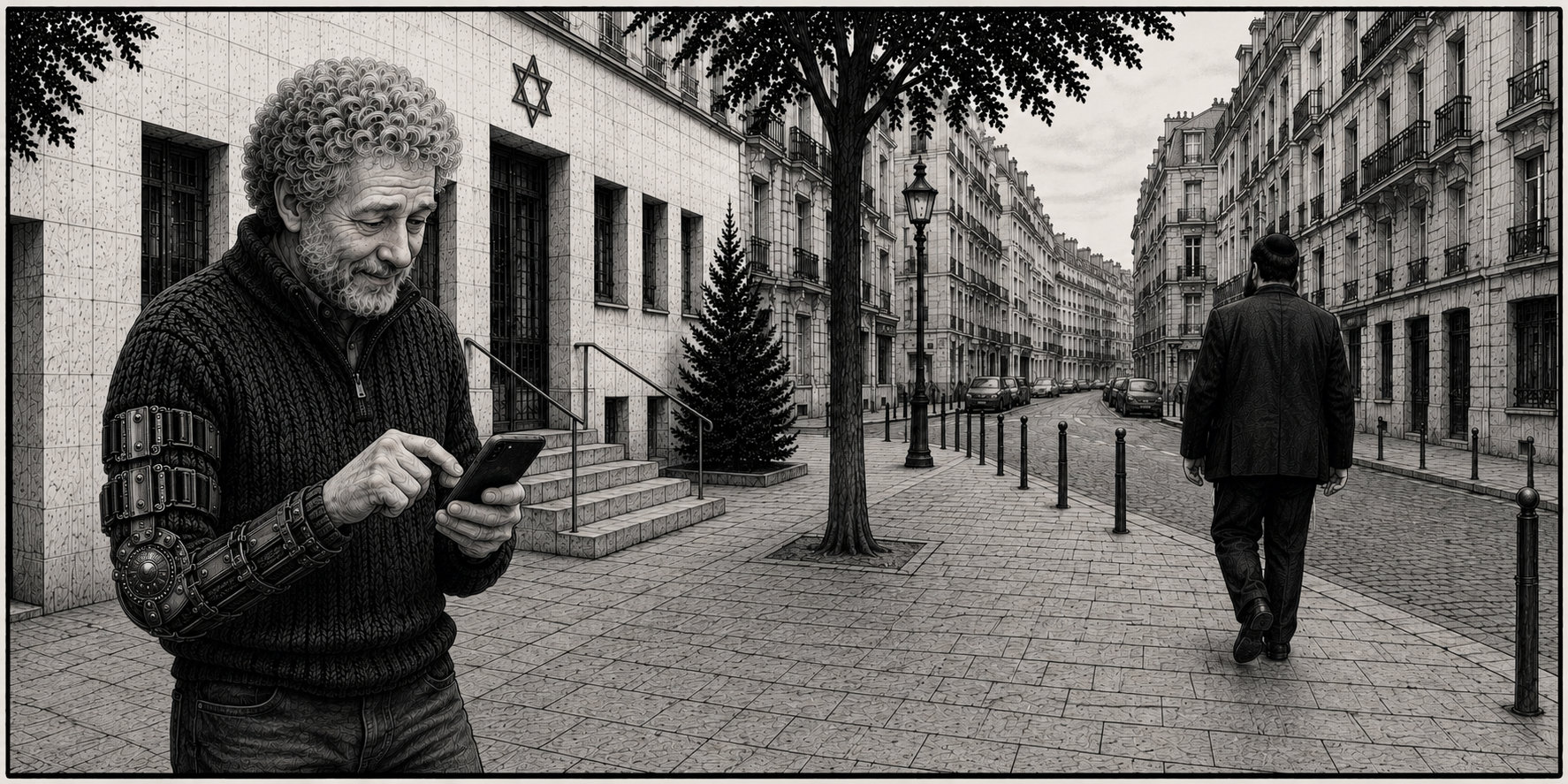
When he died, I continued to attend in order to say Kaddish for the customary 11 months, and then on every death anniversary. I still attend about once or twice a month. The rituals comfort me, and each walk to shul and back along the town’s tree-canopied greenway is a meditation that starts with “Is this it?”

map teens

Panel 3. Journey

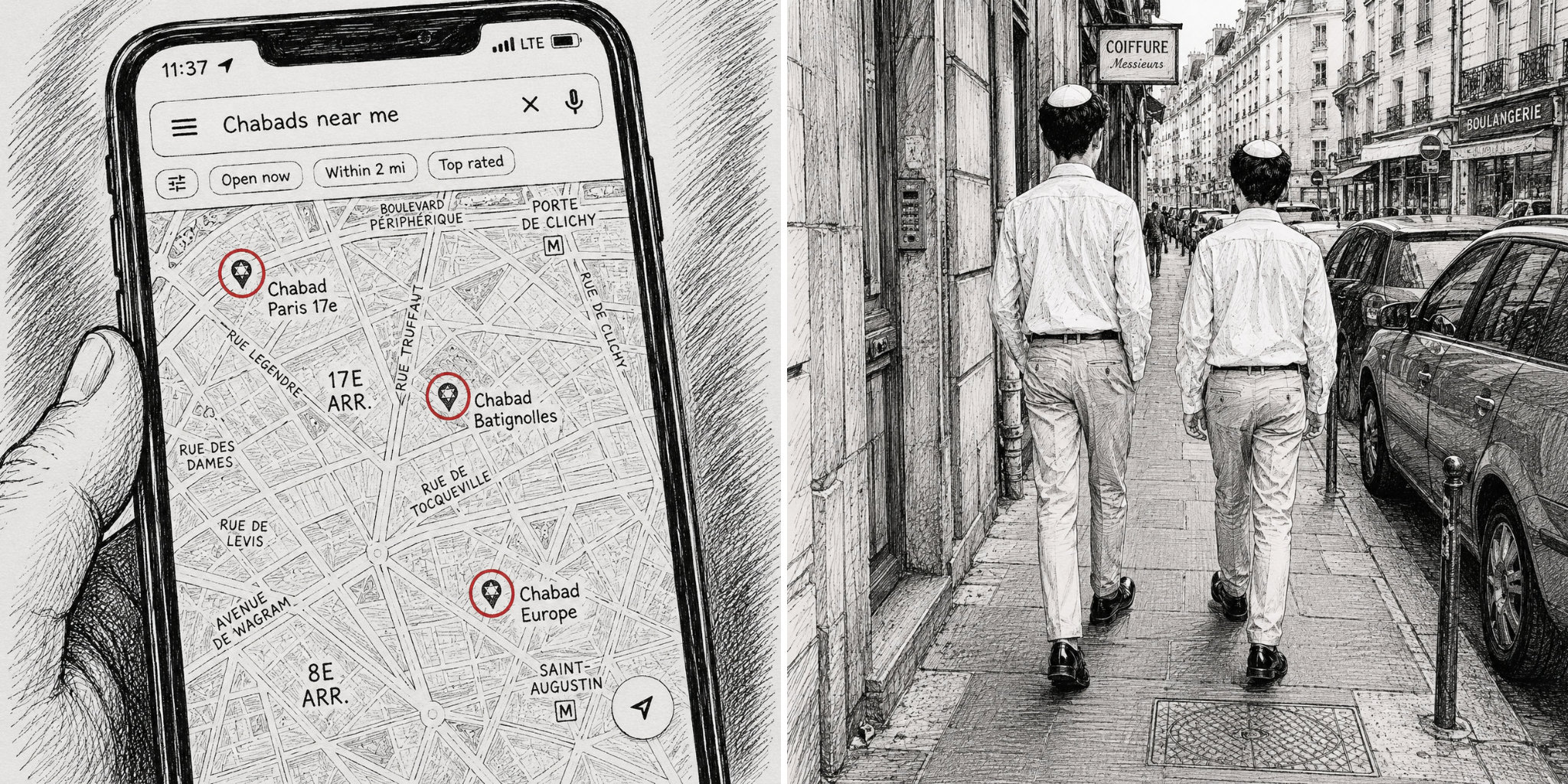
It’s Danny’s third yorzheit, and I’m in Paris visiting family. So I’m walking from my Airbnb to a nearby Chabad, and I’m worried. Last night, Google Maps found three Chabads within two miles, but all had websites that suggested congregations smaller than even my own. Kaddish must be said in the presence of 10 adult men, a tough get for a tiny Chabad. My plan is to start with the most “minyan likely” Chabad, and if no minyan, proceed to the next one, and then repeat for the third if needed.

But right now, I’m cautiously optimistic: for the last several blocks, I’ve been following two teenagers wearing yarmulkes and white, long-sleeved, button-down shirts—definitely shul bound.

map phone

Panel 4. Minyan Hunter

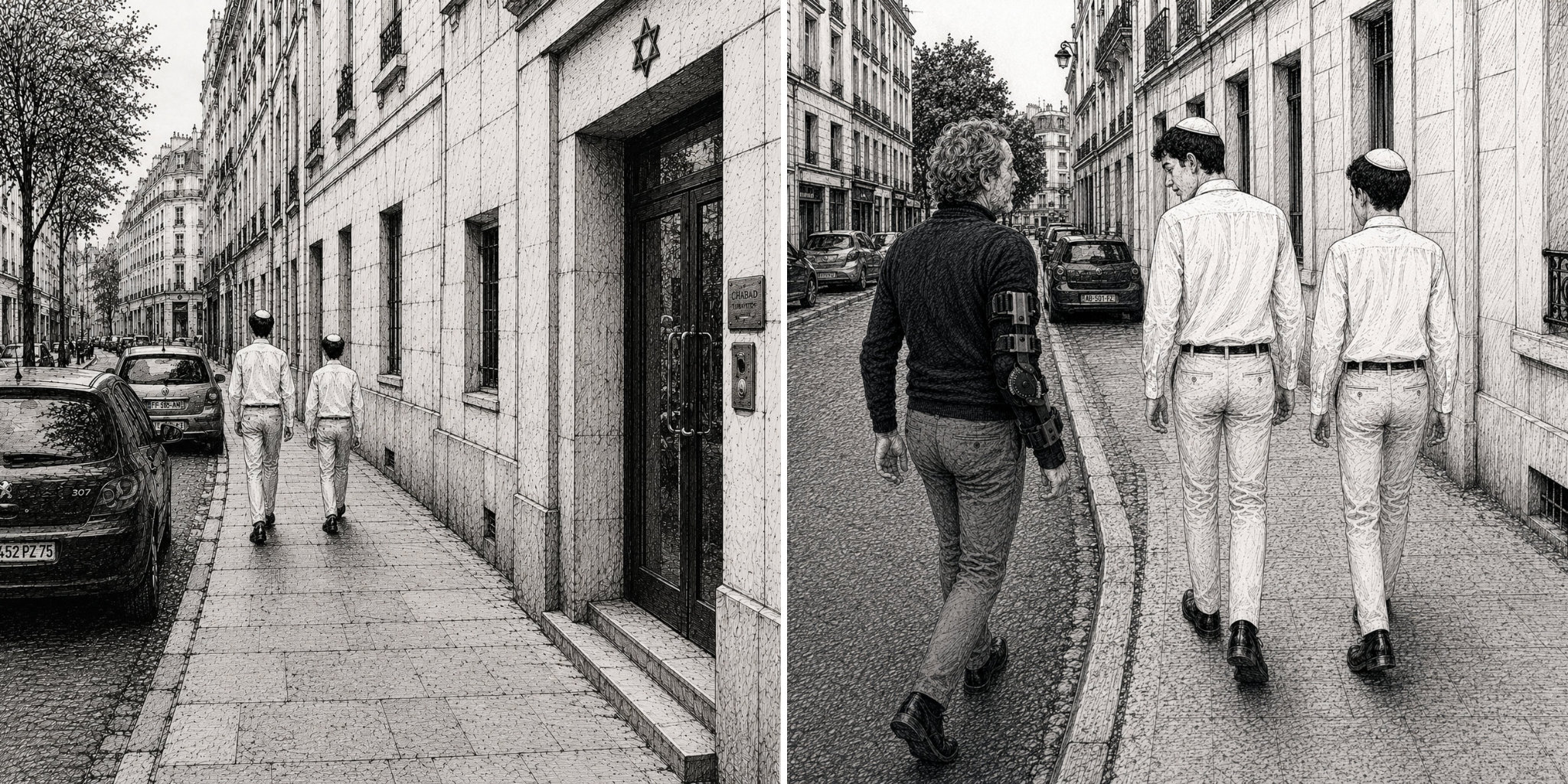
But they walk right past Chabad #1, where I see just two cars in front and no one walking in. Do I go in and see if a minyan comes? Or go to the doubtful Chabad #2 on my list? Neither. I’m going wherever those kids are headed. I hurry to catch up. They don’t look like Chabadniks—but Kaddish is the same everywhere, right?

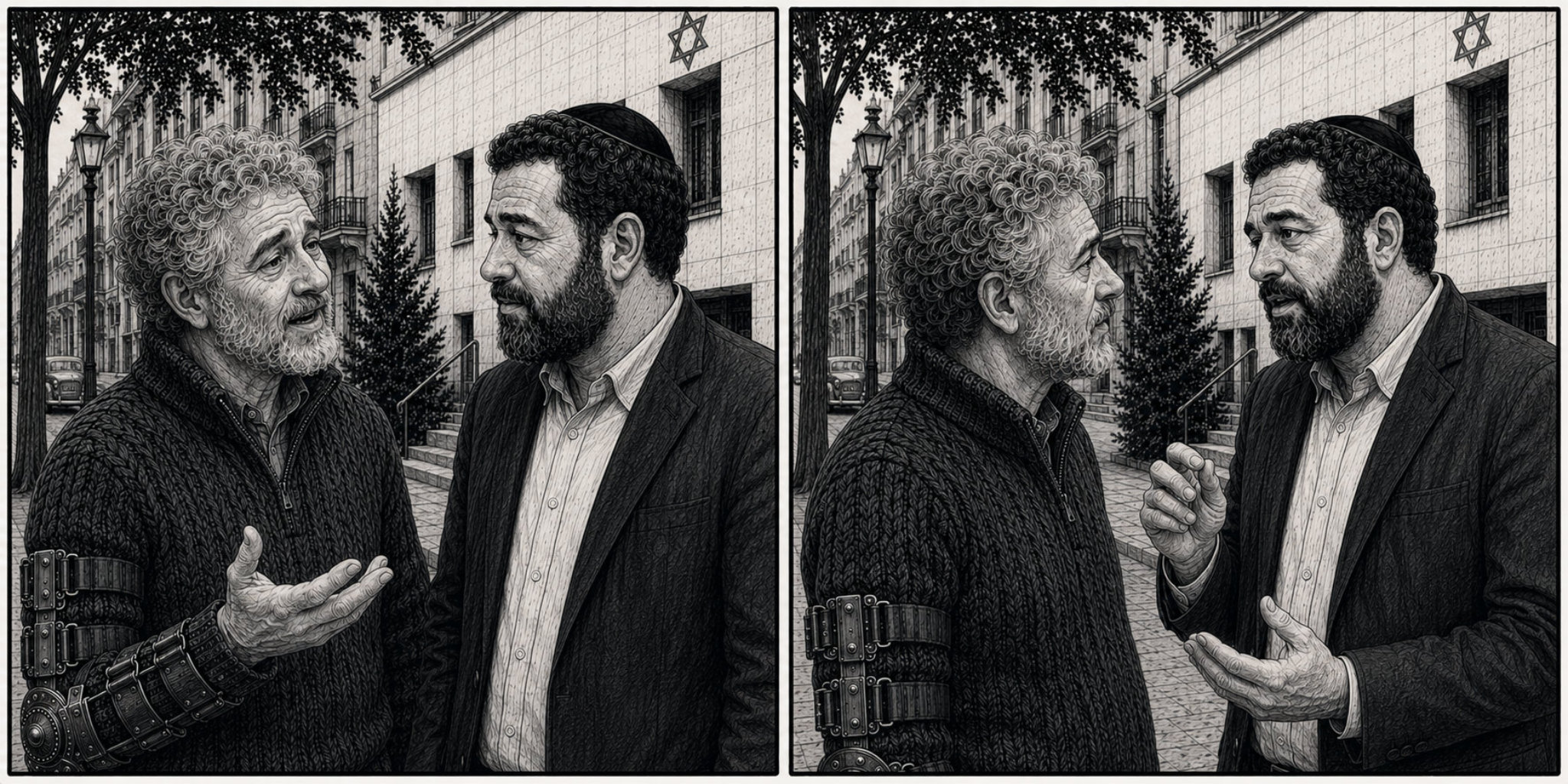
“Vous avez un minyan?” I say, coming alongside. This can’t go well; my French is shit, and my brace for a recently broken elbow looks like a robot arm. And I’m, you know, old. But the taller one gestures for me to join them. “Quel sort de synagogue? Chabad?” I ask. “Non, no Chabad,” he answers. Me: “Orthodox? Conservative? Reform?” A pause, then, “Conservative,” which could be good news for me, since women at those shuls are included in minyans.

kid points prince

Panel 5. A Bird in the Hand

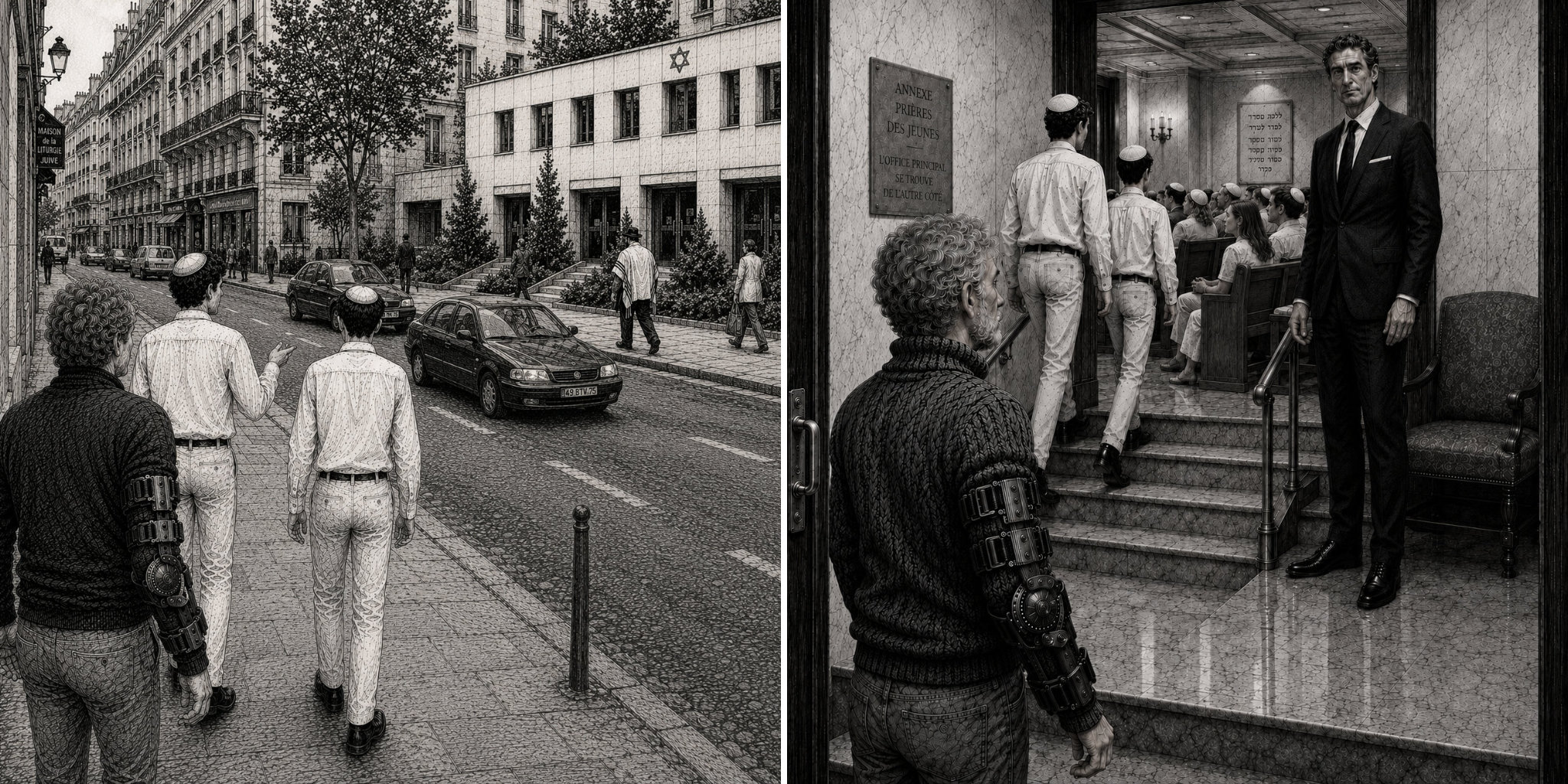
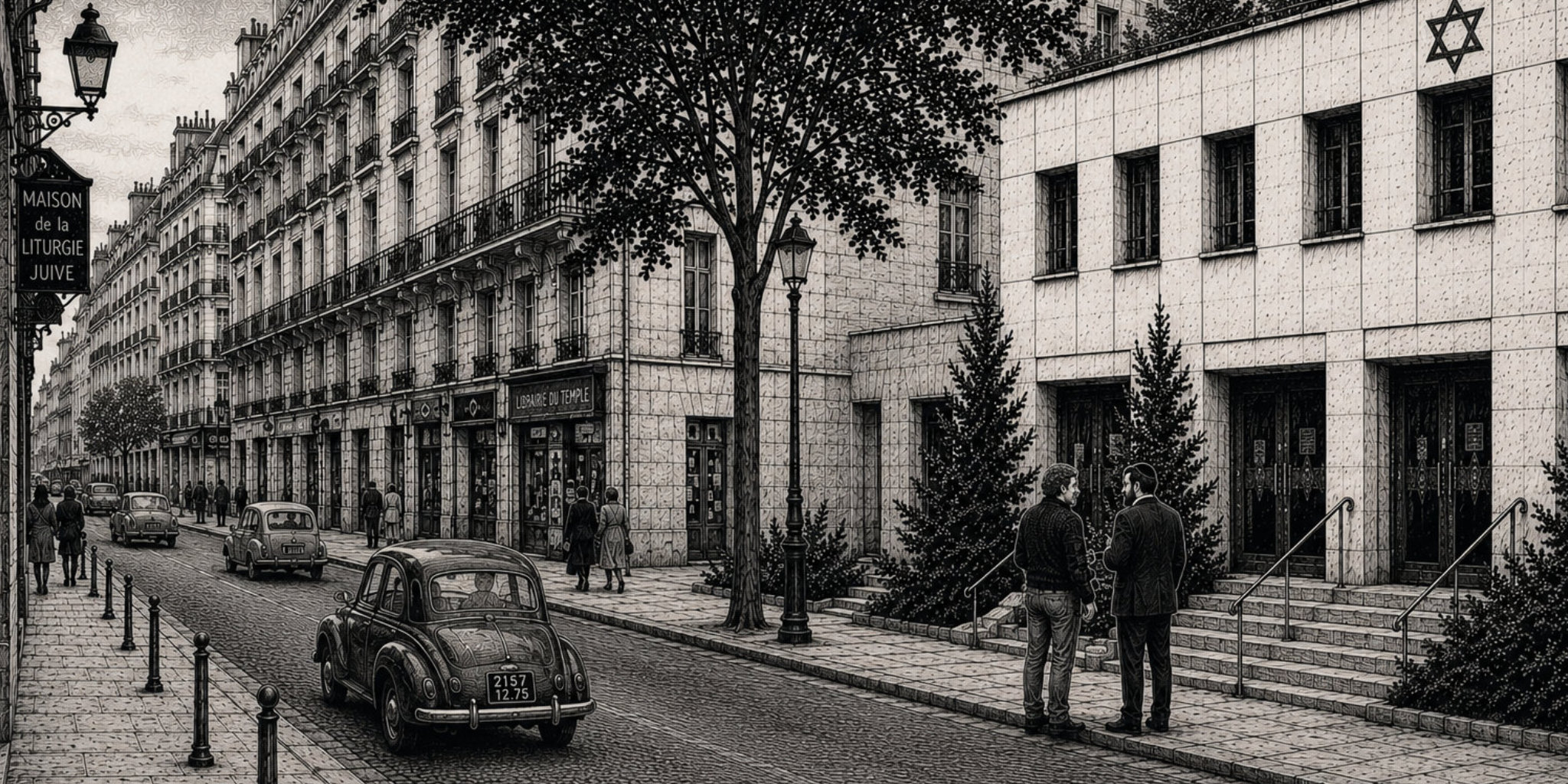
We’re half a mile past Chabad by now when the kid points to a nondescript office building and says something in French I take to mean, “That’s a synagogue there.” It’s neither of my alternative Chabads, but I see a man in front wearing a tallis. Looks promising. I note the location in case these kids’ shul doesn’t have 10.

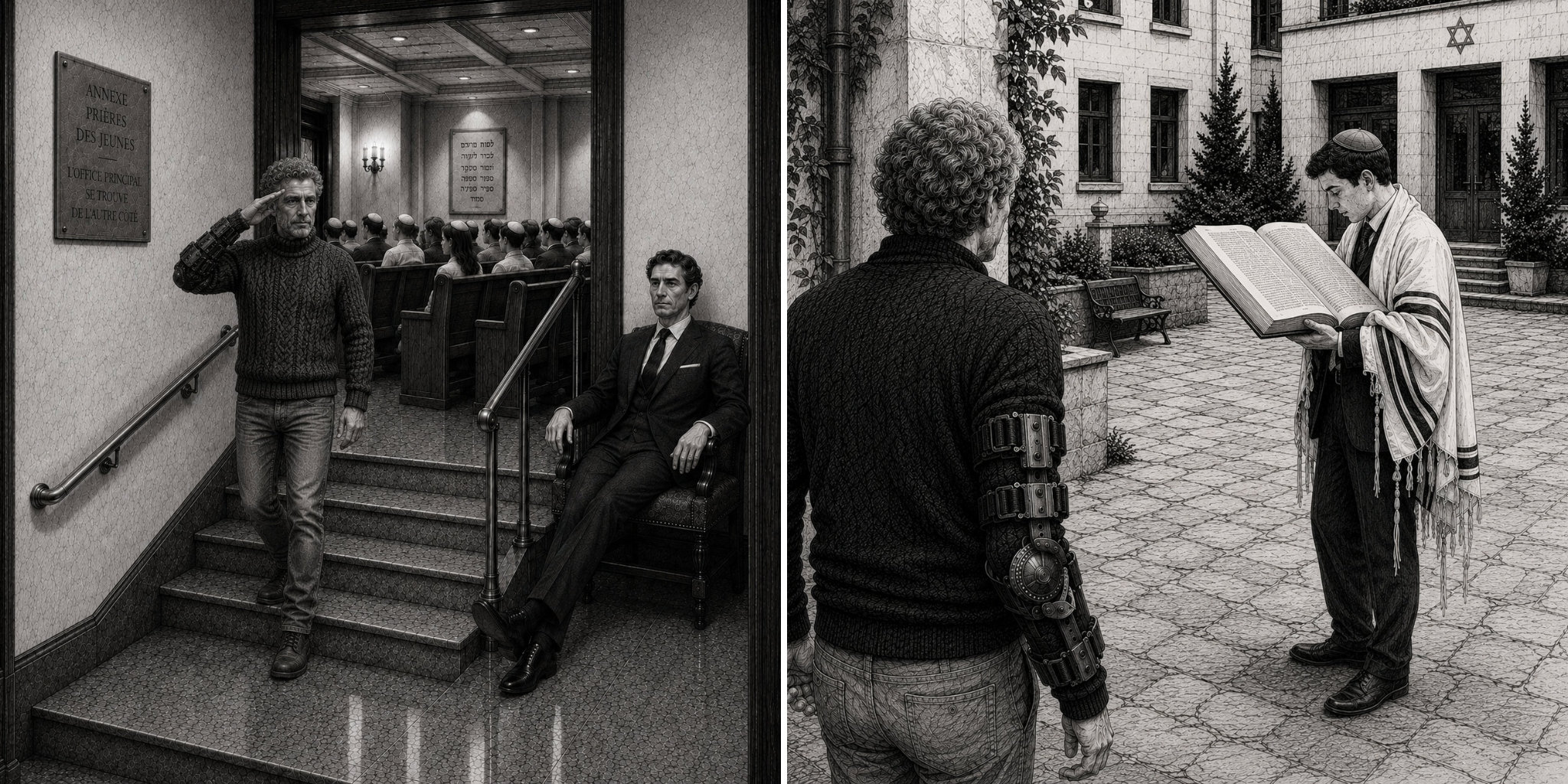
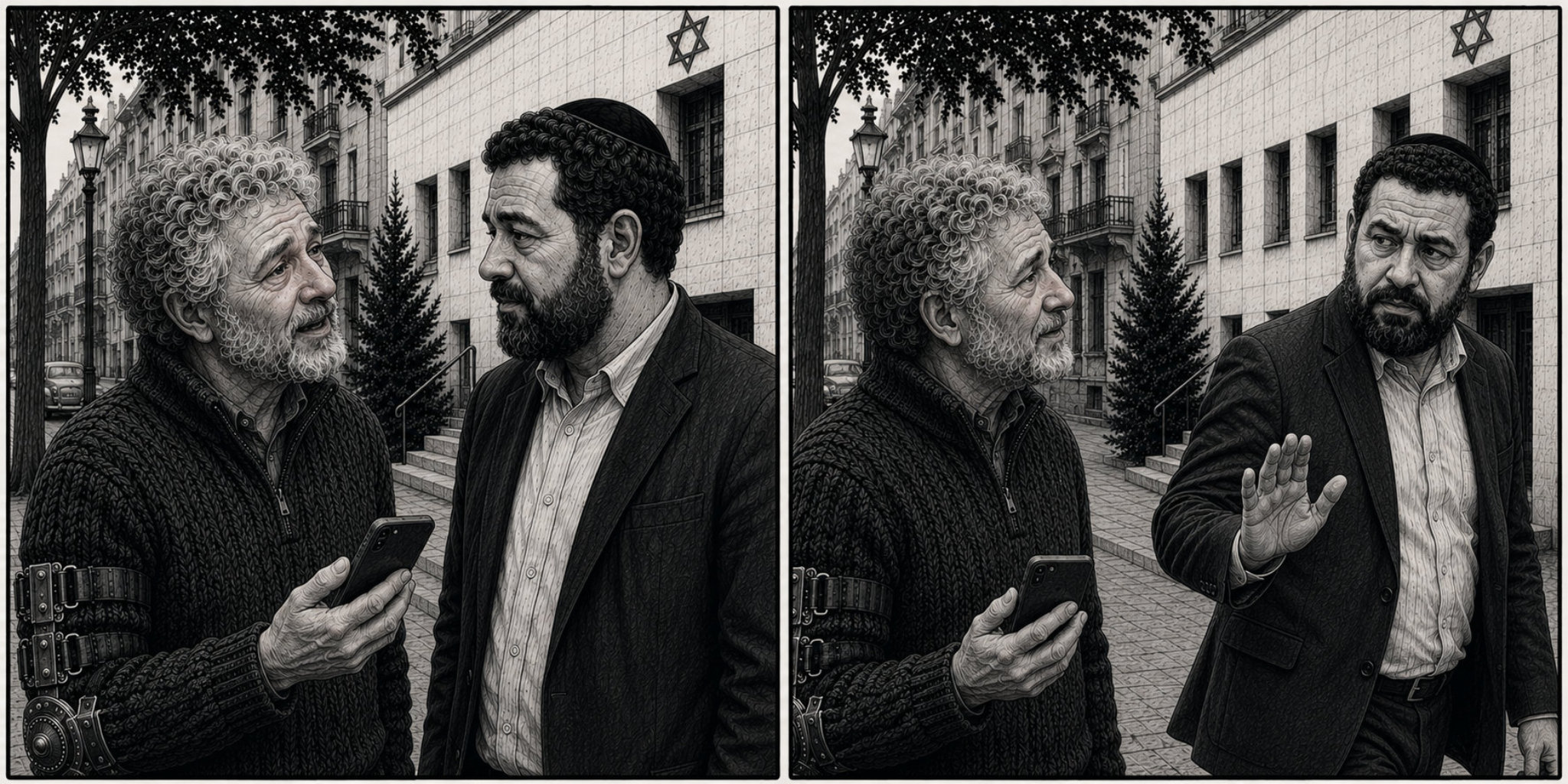
We arrive at a handsome stone building, and I follow them inside. The vestibule and sanctuary are all posh marble and shiny wood, but for me the most compelling feature is an elegantly dressed man seated in the vestibule who stands as we enter. The teens ignore him, but he glares at me. I try to disarm him with a “Shabbat Shalom,” and he raises and lowers his chin a fraction of an inch in response. Is this guy a member or a security guard? Attitude says security guard; $1,500 outfit says congregant.

tallis closet salute

Panel 6. Cheer Team

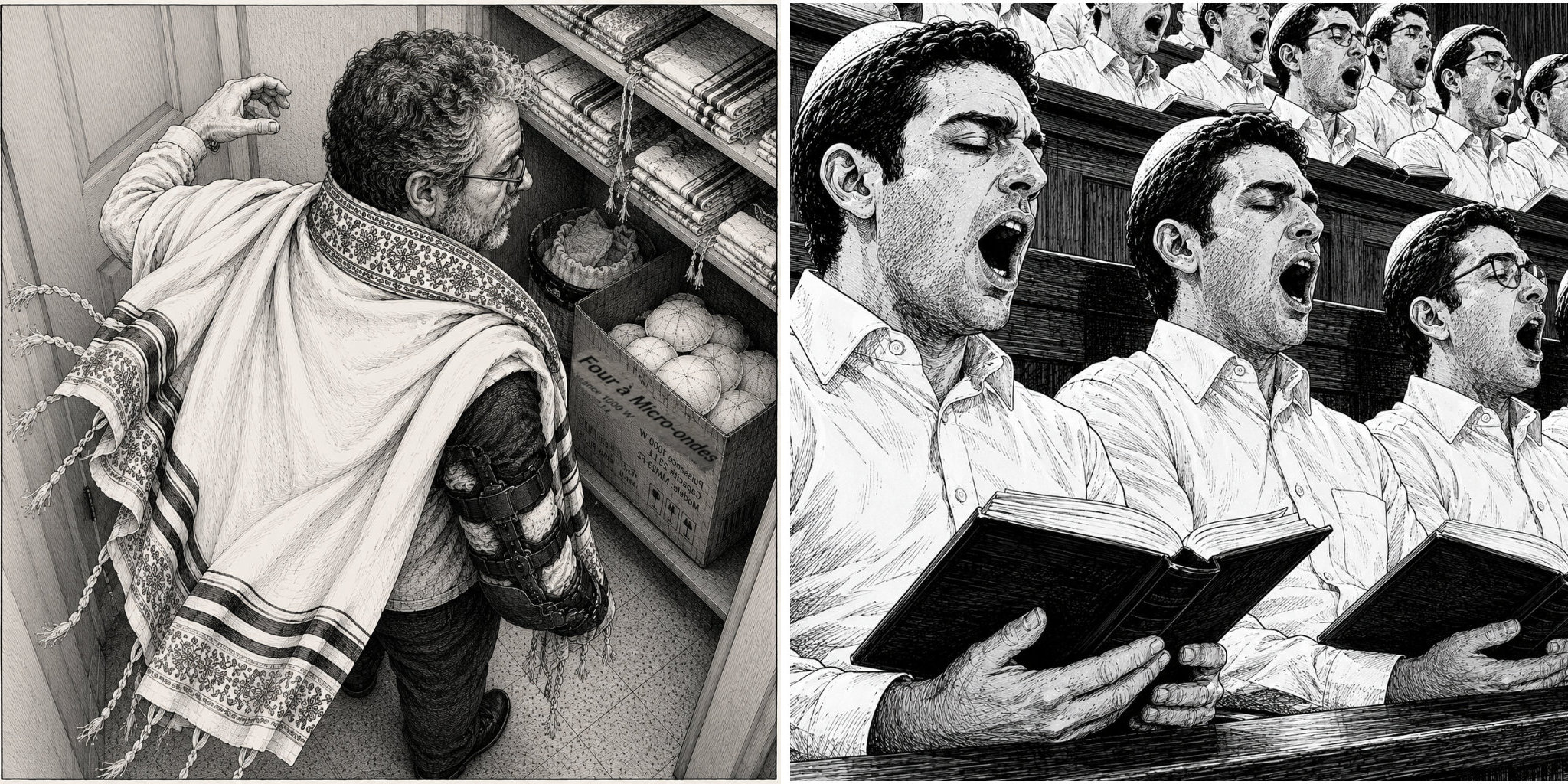
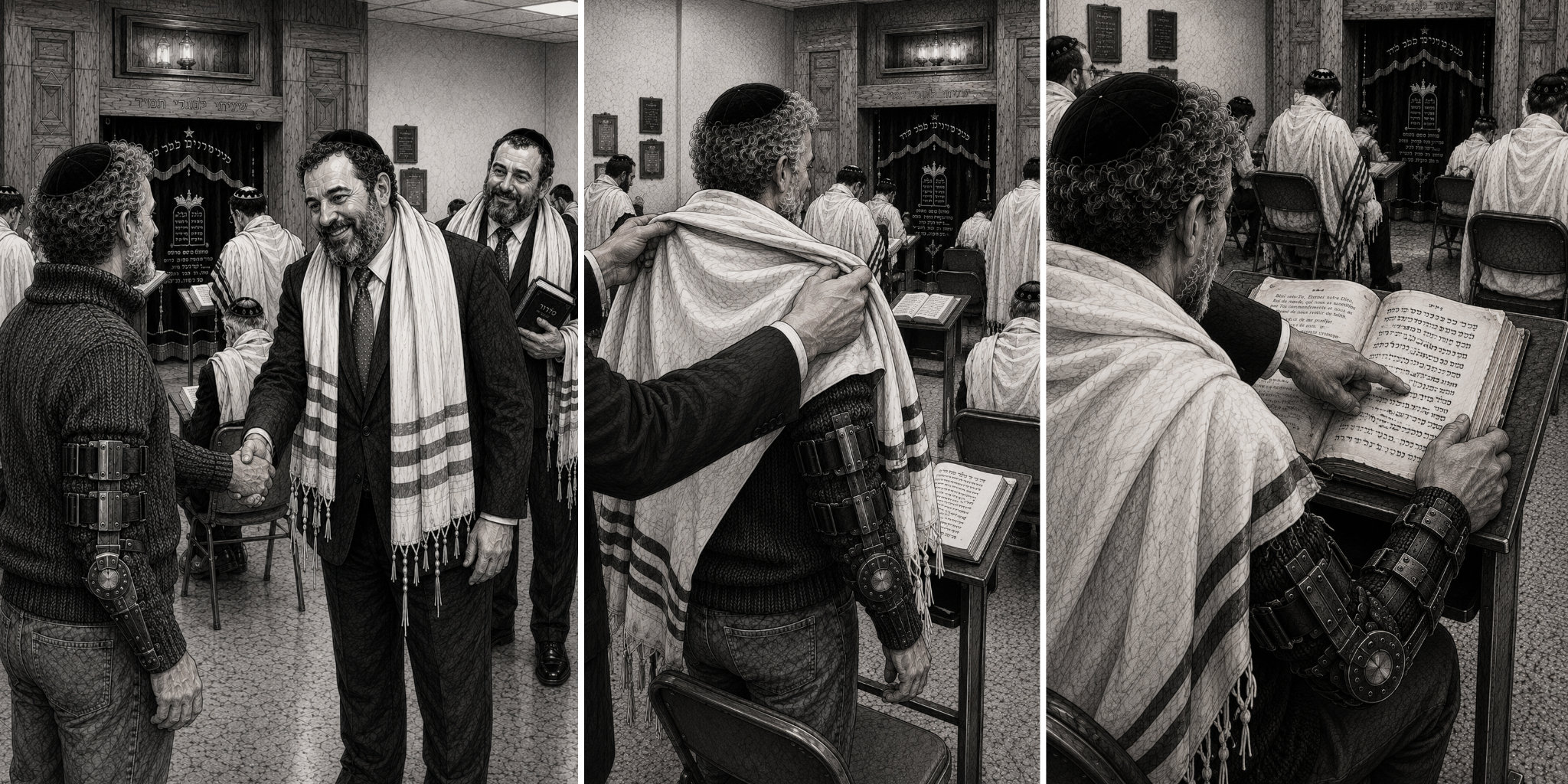
I follow the teens into the sanctuary, and the tall one shows me to a small room with tallises and yarmulkes. The tallises are the floor-length, highly decorated type I associate with the very devout, and the white gimme kipahs are the fanciest I’ve ever seen. I get the huge tallis settled around my shoulders with a lucky left-handed throw around my right shoulder and arm brace.

As I enter the annex to find a seat, I’m confronted by strange sights and sounds. Rows of identically dressed men sit in steeply descending pews facing the annex. They are loudly and rhythmically chanting prayers. It’s probably Hebrew, but in a harsh and guttural accent that makes it unintelligible to me. The constant crashing crescendos and decrescendos are unnerving. I find a seat and peek at my neighbor’s siddur for the current page, but nothing sounds familiar enough for me to find my place. All I can think about is getting far away from this scary synagogue and this bizarre and angry cheer team.

salute Home, sort of

Panel 7. Escape and Rescue

Time to leave. I wave goodbye to the teens, replace my tallis, but pocket the posh gimme yarmulke. In the vestibule, I ask the “guard,” “Les toilettes?” He looks at me contemptuously and, not bothering to stand this time, points vaguely at a hallway. I find les toilettes élégantes and salute mon ami as I pass him on the way out.

With zero confidence that the other two Chabads will have minyans, I take my chances on the shul the teen pointed out, where I saw the big guy with the tallis. I try all four entrances; locked. All windows are opaque. I go around to the side and find myself in a courtyard where a young man in a tallis is studying a very large open book. Me: “Shabbat Shalom, monsieur. Où est le minyan?” He takes me back to the front of the building and enters the door code.

wide view of the second synagogue sanctuary

Panel 8. Sanctuary

For the second time this Shabbos, I’ve found a minyan. About 25 men are singing(!) in a cluttered and modestly appointed sanctuary. I recognize the Shabbos prayer, but not the melody. No women, lots of beards, and no payes. Not Chabad, but Chabad-adjacent, probably Orthodox. Through sheer dumb luck, I have found a minyan. But it would be nice if I had someone to cue me when each Kaddish is coming in this unfamiliar service. There are usually three, but my French is shit, and I don’t have a plan other than hoping I get lucky.

kipah dangle ben points and sa frere

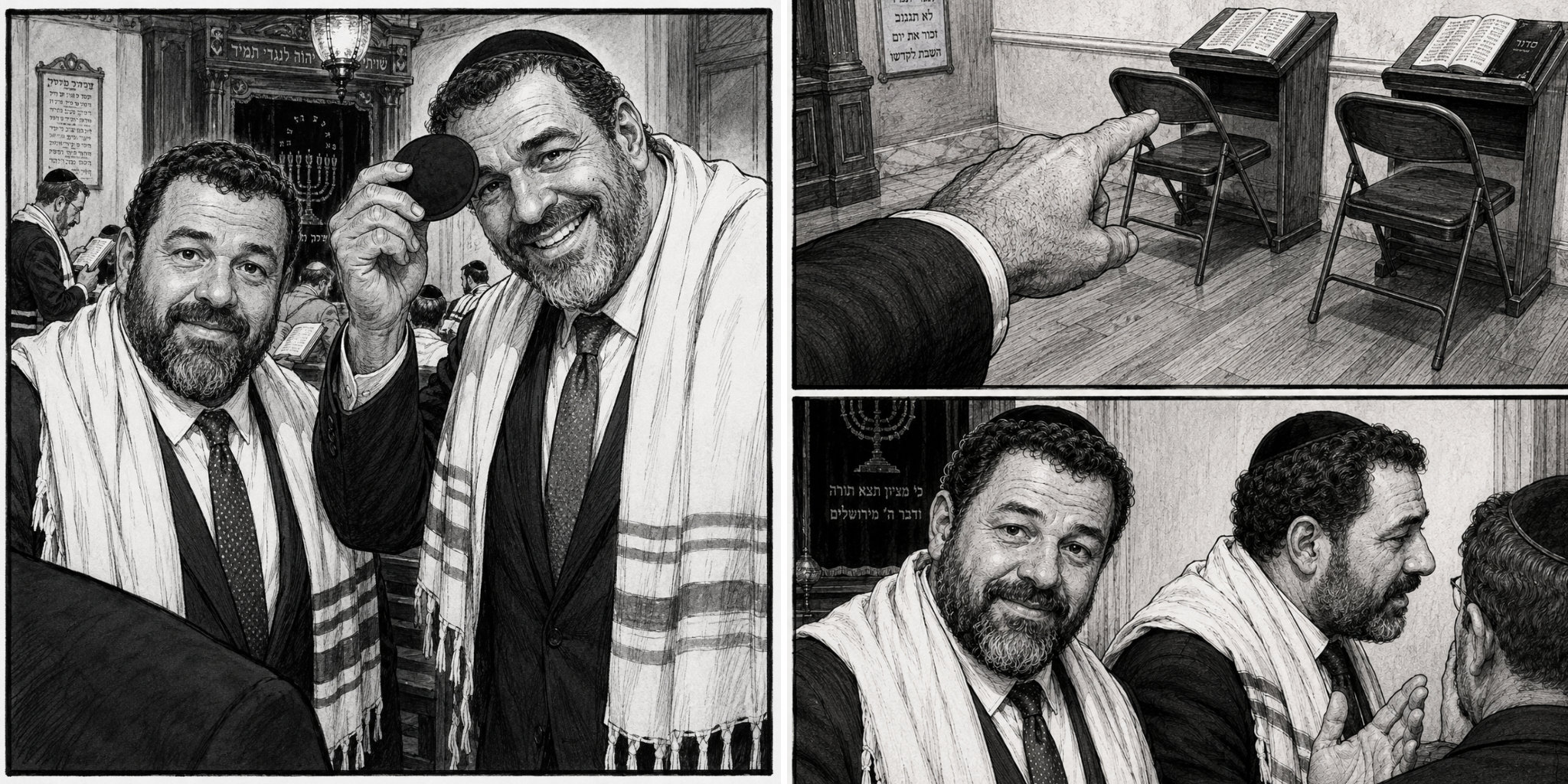
Which turns out to be the right plan. A very large man (D1 defensive tackle, 40 years later) walks up to me. He’s smiling broadly, holding a yarmulke to his head, and speaking softly so as not to disturb the service: “Would you like a kipah?” “Yes, please.” I’m laughing; his huge paw makes the kipah look like a child’s, and the gesture puts me at ease. He hands me the kipah as another almost-as-large man (D1 defensive end, 40 years later) comes up and asks, “Would you like a tallis? A siddur?” I answer with a non sequitur. “I’m here for my brother’s yorzheit.” He nods and points to two chairs. “Sit there,” pointing to the farther one. “I’ll sit next to you.” He turns to get me a tallis and siddur, I assume. As he walks away, I hear him say something to another man nearby, and I catch only “sa frère” (his brother).

composited tallis bring, tallis don, and fingerbook

Panel 9. It’s All About the Benjamin

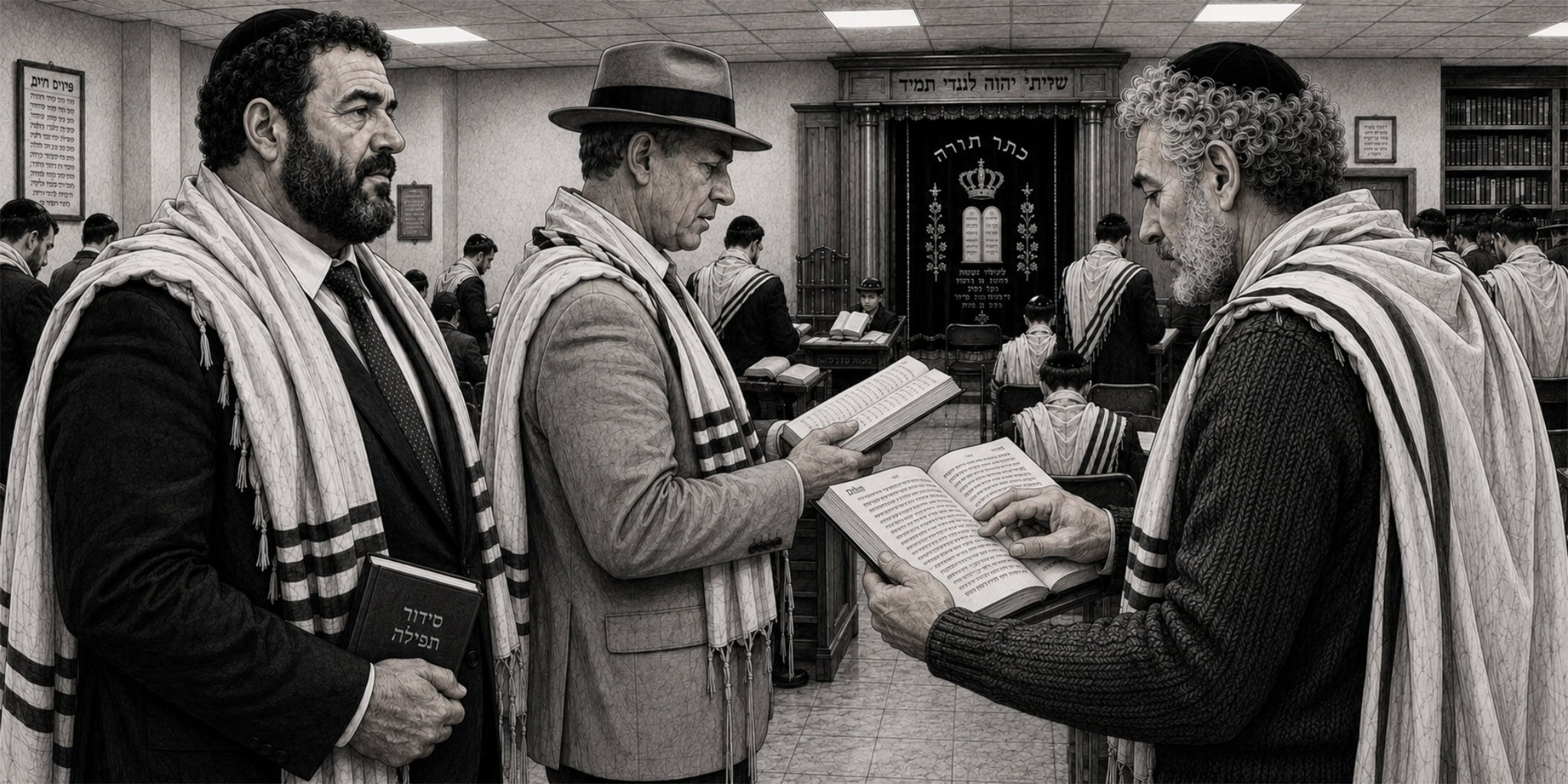
The first large man comes closer and asks in unaccented English, “Where are you from, and how do you end up here?” I laugh because I know he’s not asking what country. The French can always spot Yanks. “Arizona. I’m staying nearby for a few days with family.” He nods in recognition. “I’ve been to the Grand Canyon, and I lived a few years in Minnesota.” “College?” “No. Played hockey.” Me: “You played pro hockey in the US? NHL?” Him: “Oui, NHL.” Me: “Fantastique! I’m impressed.” “He’s Benjamin,” he says, nodding toward the man bringing my tallis and siddur. He stage-whispers so Benjamin can hear: “He played hockey, too, but only in France.” I laugh and reach to shake. “I’m Jonathan.” “Good to meet you, Jonathan. I’m Andre.” I shake hands with Benjamin too, who’s giving Andre the stink eye, but he’s smiling.

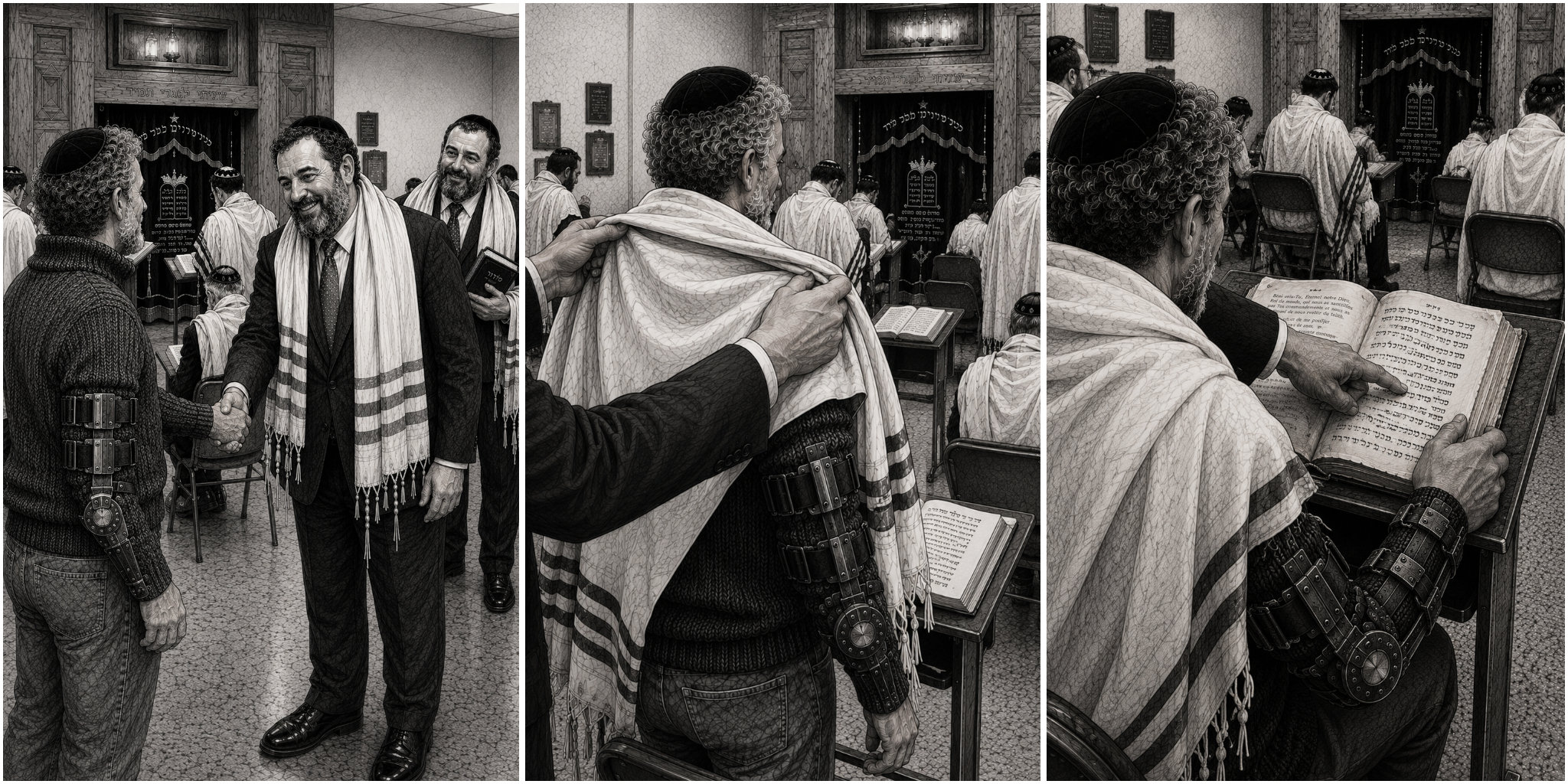
Benjamin arranges the floor-length monster tallis around my shoulders—must be all they use in France—and we sit at our shtenders. He asks, “You know Hebrew?” I say, “Yes, but only to read, and not very well.”

He nods and turns me to the correct page. From then on, as soon as he hears me struggling or lost, he points to our place, and even turns my pages if needed. He prays like a boss and knows the siddur by heart. But I’m most impressed when we reach the Torah portion of the service. Every man called to the bima reads his section of this week’s Torah portion directly from the Torah. Either the whole congregation attended yeshiva, or this shul has a very deep bench.
Panel 10. Kibbitz and Kaddish

Benjamin wants to talk, so anytime we’re not doing some critical prayer, we get to know one another. He’s got kids and grandkids—me too. He was in the French Marines—I was a Navy medic in a Marine Corps infantry company. That sort of thing. But he was also shrewdly cataloging my cultural and historical Jewishness: What generation American? From where did my parents and grandparents emigrate? Was I raised Orthodox? What was my practice of Judaism, and that of my brother? Are my children and grandchildren observant? He asked each question casually and seemed content with my answers, even those that reflected my very loose affiliation with Judaism.

ben and 2 mourners

Then things get exciting. He grabs my siddur, finds the page for Kaddish #1 (there are three), and hands it to me. I stand and begin and do OK for a few lines. But it’s been a year since my last Kaddish, and I stumble badly. I’m experienced enough to ignore mistakes, reciting at a good clip no matter how I mangle it. There are few faux pas worse than holding up the service. Kaddishes are done as quickly as possible. I wish Benjamin were saying it with me, but it’s only me and a man on the other side of the room I can barely hear. Afterwards, I look around, expecting scorn and laughter (these are Frenchmen, after all), but I see only kind expressions. As Kaddish #2 comes up, it’s Benjamin to the rescue again. He brings the other mourner alongside, and we recite together. By Kaddish #3, muscle memory has kicked in, and it goes OK.

wide view of the second synagogue sanctuary

Panel 11. Shkoyach!

The closing songs and prayers are mostly familiar, and I relax and enjoy myself. Then there’s handshaking all around, and some men even say shkoyach. Just like in my Chabad, everyone gets a shkoyach, no matter how terrible. The rabbi comes over to welcome me and kibitz a bit, invites me to come back any time, and even tells me the door code, 1720. I ask if that’s an important date in French history. He laughs: “It’s the address.”

wide view of the second synagogue sanctuary

Benjamin and I leave and stand together outside, and I assume we’re going to shake hands and go our separate ways. But he surprises me with another question. “Jonathan, what was your father’s Hebrew name?” “Chaim Velvel.” I’m betting he’s pleased to hear that Dad’s “Hebrew” name is actually Yiddish. It’s the sort of old-fashioned name that many rabbis nowadays have to ask me to repeat, but Benjamin repeats it with relish. “Chaim Velvel. And he served in the big war?” I nod. “Where? Europe?” “New Guinea and others.” It dawns on me then that I’ve answered his most important question. Dad indirectly helped win the Big War that liberated the world this man was born into. He seems to approve of Dad’s service.

ben and me

Panel 12. Q&A

But I’m also feeling a bit of the Provincial Asshole, so consumed with my Kaddish adventure that I never considered any of this. Benjamin had spent the morning asking about my family, my history, and my Judaism. I never once thought to ask about his. Feeling some shame, I ask a question that’s been nagging at me the whole service: “Are you disappointed that you had to babysit a goy like me all morning?” And he gives me an answer that’s at once scholarly and tender: “We do what we can, given our circumstances. You, Yonasen ben Chaim Velvel, are in this place saying Kaddish for Danny for your own reasons and not for Hashem’s. But Hashem isn’t concerned with your reasons, only your behavior. Whether you believe it or not, your Kaddish elevates Danny in heaven.”

wide view of the second synagogue sanctuary

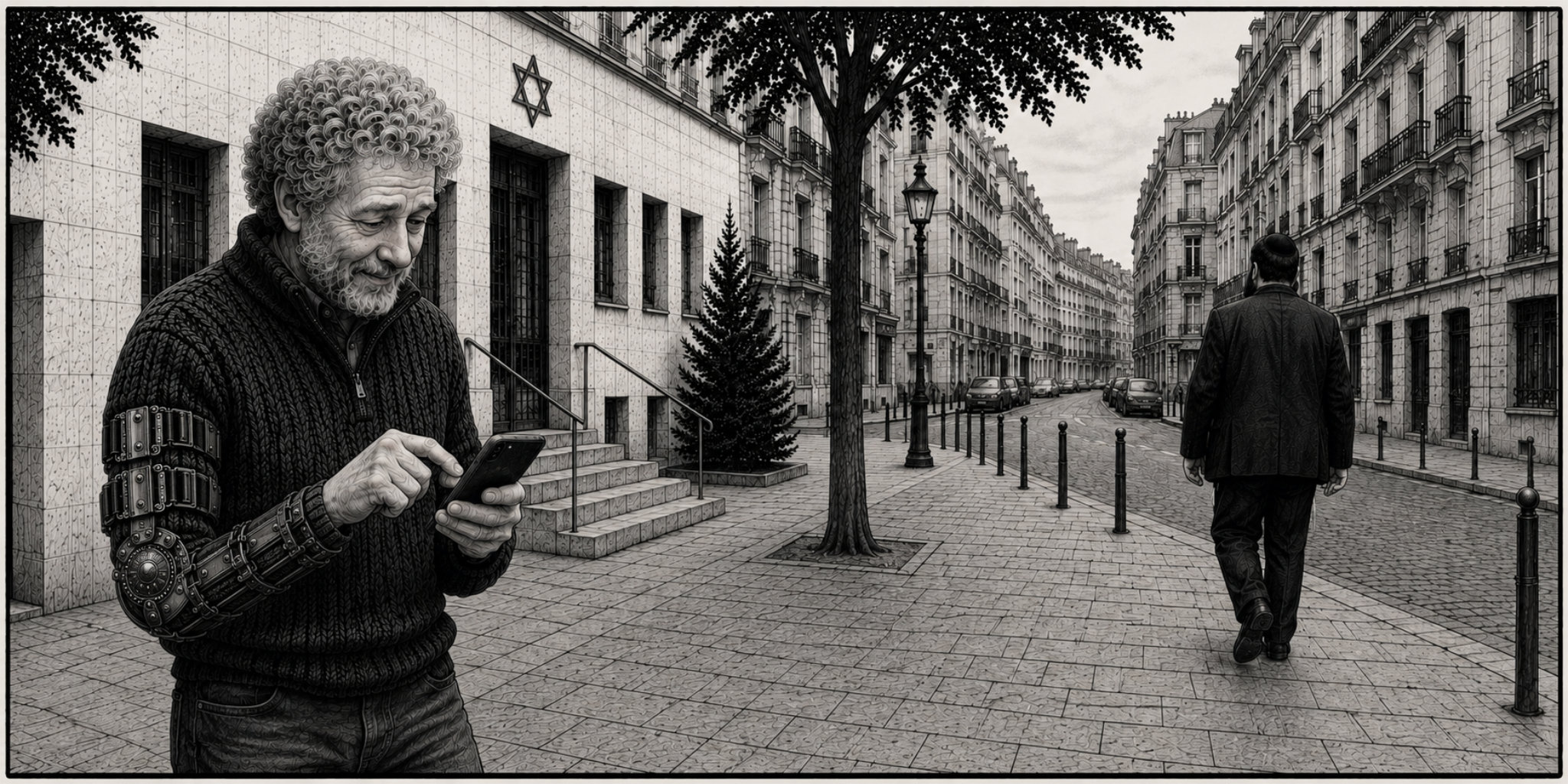
I’m crying as we shake hands, and he allows me a brief hug. I regain my voice enough to ask, “May I know your last name, Benjamin?” He tells me, and I say, “Please, I know your religious requirement, but I need to write your name down. You know I’ll forget it before I get home.” We’d talked about my dementia. He answers firmly, practically a command: “No! Of course you can’t do that.” But he sees the phone in my hand as he walks away. His expression says he knows I’m going to write it down, and he’s not happy about it.

PA writes the name

Panel 13. The Provincial Asshole Writes Down the Name

Notes

Very Scary Cheer Team, Explained
While unpacking, I found the posh yarmulke I'd pocketed and was happy to see that the shul's name was printed on the inside. Later research revealed that the shul uses a traditional North African liturgy that includes loud and rhythmic chanting, guttural and nasal intonation, and occasional clapping and foot stomps. About 5% of Paris synagogues employ this liturgy, and many of those are in or near the arrondissement where I was staying.
Teen Said His Shul Was Conservative, Explained
My question to him, "Orthodox, Conservative, or Reform?" was culturally ignorant gibberish. Only the term Orthodox is common in France, but it refers to shuls that adhere to Ashkenazi traditions. The kid likely answered "conservative" (after a longish pause) because conservative (lowercase c) means the same thing in French and English. Given my question, he chose the best answer he could.
Guy with Huge Book and The Deep Bench Explained, A Twofer
After returning home, I found the shul online and learned it's also a Yeshiva. This is a twofer: 1. The guy in the courtyard was holding a chumash, a book that includes the weekly Torah sections (parshas) along with centuries of commentary on those sections. 2. The guy was preparing for his aliyah that day, during which he would read part of that week's parsha. No shul has a deeper bench than a school that trains rabbis.
Scary Synagogue Fashion Prince, Explained
After telling my sister this story, she said Benjamin and Andre were obviously security, and I think she was right. They were almost certainly congregants who are tasked with keeping an eye on the door. No coincidence that they also happened to be huge former hockey players. In my shul, one or another member carries a piece and sits by the door. As for the Fashion Prince, I'm now leaning towards congregant.
Angry Benjamin, Explained
His anger was a surprise. Until then, he'd seemed unconcerned about my lack of observance. Why would my writing on Shabbos upset him? My first reaction was hell with him, I've got my own shit to deal with. But while walking back to the apartment, I realized that by asking him for his permission, I had made him complicit in violating Shabbos custom. I should have kept my phone in my pocket, asked for his last name, and written it down after he left.
Fudge Making, Explained
Heapingscorn (me) composed the narrative and designed the images. GPT rendered the images, wrote the glossary, and repeatedly prevented the Provincial Asshole from wandering into traffic. (She wrote this Note as well.)

Glossary

Chabad (khah-BAHD, with a rough back-of-the-throat kh)
A Hasidic Jewish movement known for outreach, small local centers, and welcoming Jews of every level of observance.
Chabadnik / Chabadniks (khah-BAHD-nik)
The narrator's possibly impolite Yiddish neologism for people associated with Chabad. The proper term is Lubavitcher, meaning someone associated specifically with Chabad, or Hasid, meaning someone belonging to one of several devout and often mystical forms of Judaism.
Conservative
A modern Jewish denomination between Orthodox and Reform in practice and theology. In this story, the term is also a source of confusion because French synagogue categories do not map neatly onto American ones.
Goy / Goyim (rhymes with “boy”)
A non-Jew. Depending on speaker and context, neutral, affectionate, comic, or insulting.
Hashem (hah-SHEM)
Literally “the Name,” a respectful way of referring to God.
Hebrew name
A Jewish ritual name, often used in prayers, synagogue honors, and memorial observances. Traditionally paired with a parent’s Hebrew name: Yonasen ben Chaim Velvel, Jonathan son of Chaim Velvel.
Kaddish / Kaddishes (cod-ish)
A prayer recited by mourners. It does not mention death; it magnifies and sanctifies God’s name.
Kipah / Kipahs (kee-PAH)
A Jewish skullcap. Also called a yarmulke.
Minyan / Minyans (MIN-yun)
The quorum required for certain public prayers, traditionally 10 adult Jewish men in Orthodox practice.
Mishabeyrakh (mee-shah-BAY-rokh)
A prayer asking for healing, often offered by naming someone who is ill.
Orthodox
A branch of Judaism that maintains traditional Jewish law and practice, including gender-separated prayer in many synagogues.
Payes (PAY-us)
Sidelocks worn by some Orthodox Jewish men and boys.
Reform
A liberal Jewish denomination, generally less bound by traditional Jewish law.
Shabbos (SHAH-biss)
The Sabbath, from Friday evening to Saturday night. Modern Hebrew: Shabbat.
Shabbat Shalom (shah-BAHT shah-LOAM)
“Peaceful Sabbath,” a common Sabbath greeting.
Shkoyakh (SHKOY-akh)
Short for yasher koyach, a congratulatory “well done” often said after someone participates in a service.
Shul / Shuls (shool)
Yiddish for synagogue.
Siddur / Siddurim (sid-DOOR)
Jewish prayer book.
Shtender / Shtenders (SHTEN-der, rhymes with “vendor”)
A small lectern or reading stand used during prayer or study.
Tallis / Talleisim (TAH-liss / tah-LAY-sim)
Prayer shawl worn during services. Modern Hebrew: tallit; plural tallitot.
Torah (TORE-ah)
The Five Books of Moses, handwritten on a scroll and read publicly in synagogue.
Yarmulke / Yarmulkes (YAH-muh-kah)
Yiddish term for a kipah.
Yeshiva / Yeshivas (yeh-SHEE-vah)
A Jewish religious school focused on Torah and Talmud study.
Yorzheit / Yorzheits (YOR-tsite)
Anniversary of a death, traditionally marked by saying Kaddish and lighting a memorial candle. More common English spelling: yahrzeit.
← Back to Home